
Why Trusting Your Art Process Is So Hard (And What to Do When You Can't See the Outcome Yet)
This week, I ruined a painting. Or at least, that's what it felt like in the moment.
I was working on an owl butterfly hybrid, a barn owl face painted over India ink, with washes of watercolor and gouache layered on top. The ink is my base layer. It's a process I love. And then, right in the middle of the face (which is supposed to be almost white, the way barn owls are), a big splash of black ink landed exactly where I didn't want it.
See? You would never know that I dripped ink all over his face!
This week, I ruined a painting. Or at least, that's what it felt like in the moment.
I was working on an owl butterfly hybrid, a barn owl face painted over India ink, with washes of watercolor and gouache layered on top. The ink is my base layer. It's a process I love. And then, right in the middle of the face (which is supposed to be almost white, the way barn owls are), a big splash of black ink landed exactly where I didn't want it.
I couldn't wipe it up. India ink is immediate and permanent on paper. So I had to make a choice: panic, tear the page out, start over, or trust the process and keep going.
I kept going. I filled in the rest of the face with the dark ink, reminded myself that gouache is opaque (it can cover anything), and decided to see what happened.
What happened is that it became one of the moodiest, most atmospheric pieces I've made. The dark underlayer gave it depth. It enhanced the evening feeling I was going for, something I couldn't have planned if I tried.
But here's the thing: I could only trust the process because I knew something. I knew gouache could cover it. I knew the ink would add depth. I had enough experience to take the leap.
What do you do when you don't have that certainty? What do you do when you're in the middle and you genuinely cannot predict the outcome?
The Middle Is Genuinely Unpredictable (And That's Not a Personal Flaw)
I want to be honest with you about something, because I think a lot of artist advice glosses over this part: trusting the process doesn't mean you know how it ends. It means you stay in it anyway, without that guarantee.
Right now, I'm working toward licensing my artwork. And there are weeks where I feel completely aligned, clear on my direction, energized, confident. And then there are weeks where I'm scrolling, comparing, questioning whether any of this is actually going anywhere.
The thought that lands hardest during those doubt-weeks isn't loud or dramatic. It's quiet and it sounds educated. It sounds like: what if no one wants this? What if I can't actually make a living doing this?
That thought brings exhaustion with it. And the exhaustion can start to feel like a signal, like maybe it's your nervous system telling you something is wrong. But I've started to wonder if exhaustion in the middle might actually be a sign that you are working toward something real. Something that matters enough to scare you.
What "Trusting the Process" Actually Requires
I used to think trusting the process was a mindset thing, like if I believed hard enough, the doubt would go away. It doesn't work like that, at least not for me.
What I've found is that trust isn't the absence of doubt. It's showing up in the presence of it.
With my painting, I trusted the process because I had a technical foundation to lean on. I knew what gouache could do. In the bigger picture of building a creative career, the equivalent of that technical foundation is consistency. Every day I show up and make something, I'm adding to what I know. I'm sharpening my eye. I'm expanding what I'm capable of. I'm building a body of work that compounds over time.
The process only works if you stay in it long enough for it to work. And staying in it is the hard part, especially when you are squarely in the middle and the outcome is genuinely unknown.
Rejection as Direction, Not Verdict
Something has shifted in me around rejection lately. It doesn't feel as final as it used to.
A "no" tells me something. It makes me look closer at my work. It makes me tighten, refine, and adjust. It's uncomfortable, genuinely uncomfortable, but it's also useful information. Like the splash of black ink: it doesn't mean the painting is ruined. It means I have to find a new way through.
I think the artists who make it are not the ones who avoid rejection. They're the ones who learn to read it differently. Not as a verdict on their worth, but as a signal about direction.
When You Feel Like You've Ruined Everything: A Practical Reset
When I hit that moment in a painting where I'm sure I've destroyed it, I've learned to do one thing: walk away. Sometimes I move to another piece. Sometimes I sleep on it. And almost always, when I come back with fresh eyes, I can see the path forward.
The "ruin" is almost never actual ruin. It's usually over-focus. It's my brain being too close to the work for too long.
The same is true in bigger creative seasons. If you're feeling like everything is falling apart or stalling out, it's worth asking: when did I last actually step back? Not quit, just breathe. Reset your nervous system. Come back with distance.
Exhaustion can masquerade as failure. Confusion can masquerade as incompetence. Give yourself the chance to tell the difference before you make any decisions about stopping.
If You're in the Middle Right Now
If you're applying and hearing nothing back. If you're creating consistently but can't see the traction yet. If you're doubting whether your work is good enough, or whether you started too late, or whether anyone actually wants what you're making, I want to say this clearly:
The middle is supposed to feel like this. It is not a sign you are doing it wrong.
You cannot see the outcome from inside the process. That's not a flaw in you, it's just the nature of the middle. The barn owl face was solid black before it was a moody, atmospheric painting. You can't always know what something is becoming while it's still being made.
What I know is that I'm still here. Still painting, still applying, still refining, still showing up on the days when I can't see where it's going. And I believe, genuinely, that the showing up is what builds the path. Not before you walk it. While you walk it.
Keep going, beautiful soul.
If You Want to Watch the Shaping in Real Time
I share this whole stage inside my Patreon, the works in progress, the portfolio building, the experimenting, the refining. It's not polished. It's honest. And if you're building something too, I think you'd feel right at home there.
And if you're feeling lost in the woods right now and need help reconnecting with your North Star, the Starlight Dream Lab is a beautiful place to begin. It's where we do the deeper work of remembering what you're actually building toward.
How to Find Your Art Style When You Like Too Many Things
If you’ve ever thought, “I like too many things, I’ll never find my art style,” I want you to take a breath right now.
Because what if the problem isn’t that you like too many things…
What if the problem is that you’ve been taught the wrong order?
For a long time, I believed I needed to figure out my style first before I could put myself out into the world as an artist. Before I could show my work. Before I could pursue licensing, illustration, or meaningful opportunities.
And without realizing it, finding my style became a barrier between me and actually doing the work.
That belief quietly feeds perfectionism.
It delays momentum.
And it keeps artists endlessly “preparing” instead of participating.
If that sounds familiar, this post is for you.
(And Why Liking Many Things Is Not the Problem)

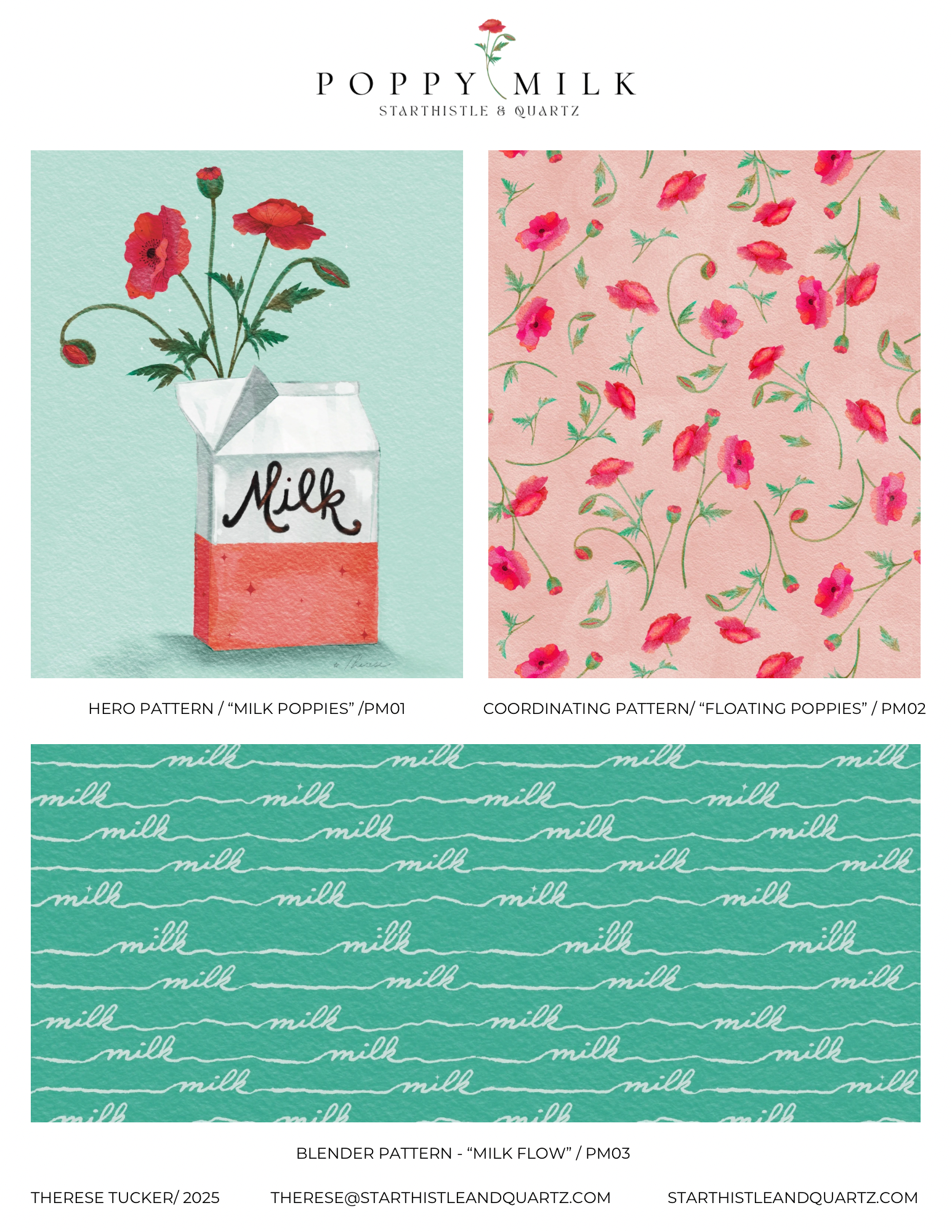
My “Poppy Milk” mini collection from 2025
If you’ve ever thought, “I like too many things , I guess I’ll never find my art style,” I want you to take a breath right now.
Because what if the problem isn’t that you like too many things…
What if the problem is that you’ve been taught the wrong order?
For a long time, I believed I needed to figure out my style first before I could put myself out into the world as an artist. Before I could show my work. Before I could pursue licensing, illustration, or meaningful opportunities.
And without realizing it, finding my style became a barrier between me and actually doing the work.
That belief quietly feeds perfectionism.
It delays momentum.
And it keeps artists endlessly “preparing” instead of participating.
If that sounds familiar, this post is for you.
When “Finding Your Style” Becomes a Trap
Here’s something I don’t hear talked about enough:
A huge part of discovering your style doesn’t happen in private.
It happens after you put your work out into the world.
It happens when:
You notice which pieces people respond to (and which they don’t)
You feel into what doesn’t feel aligned anymore
You receive feedback, even neutral or confusing feedback
You realize what’s missing from your portfolio
You see patterns in what you keep returning to
You can’t get that information by waiting until everything feels perfect.
And yet, many artists treat style like a gatekeeper:
“Once I figure this out, then I’ll be ready.”
In my experience, it’s the opposite.
Readiness comes from repetition, exposure, and choice, not certainty.
Liking Many Things Doesn’t Mean You’re Unfocused
For a long time, I interpreted my wide range of interests as a flaw.
I love:
Gouache and mixed media
Digital illustration and surface design
Animals, women, florals
Mythical, whimsical, storybook worlds
Minimal, chic aesthetics and rich, narrative depth
Children’s books and licensing art for everyday objects
At one point, all of that felt like evidence that I lacked direction.
Now I see it differently.
Liking many things usually means:
You have a wide field of vision
You’re sensitive to nuance
You’re capable of world-building, not just one-off images
You’re meant to work relationally, not narrowly
It doesn’t mean you lack direction.
It means you need cohesion, not restriction.
The Shift That Changed Everything: Working in Collections
The biggest breakthrough in my creative process came when I stopped asking:
“What is my style?”
And started asking:
“What story am I telling, and how can these pieces belong together?”
Working in collections changed everything.
Before that, I created mostly one-off pieces:
Intuitive bursts of inspiration
Beautiful moments, but disconnected
Little momentum
No clear throughline for my audience (or myself)
Once I began working in collections, clarity followed naturally.
Not because I forced a style, but because I made consistent choices.
My Current Framework (You Can Borrow This)
Here’s the simple framework I use now:
Theme → Constraints → Story → Exploration
Instead of waiting for inspiration to strike perfectly, I begin with structure that still allows play.
1. Start with a Theme
This might be:
A place (the woods, a village, the night)
A concept (time of day, seasons, mythology)
A feeling (quiet magic, nostalgia, wonder)
Right now, my Patreon collection Moonrise Menagerie is built around woodland settings, mythic animals, and the progression of time across a single day.
2. Add Constraints (This Is Where Style Begins)
Constraints reduce pressure and increase cohesion.
The things I consciously limit:
Color palette (this is always my doorway in)
Location or setting
Tools & materials (very limited brushes or media)
Motifs (animals, flowers, stars, repeated symbols)
Texture & line weight
When you remove infinite options, your preferences start to speak.
3. Let the Story Lead
Instead of asking, “Am I good enough?”
I ask, “What am I trying to give?”
That shift moves the focus:
Away from self-judgment
Toward connection
Toward the viewer’s experience
Story creates momentum. Style follows.
4. Keep Composition Flexible
I intentionally leave room for play.
I might have a loose idea, but I allow:
Accidents
Discoveries
Adjustments mid-process
Some of my strongest moments happen because I didn’t over-plan.
Why This Quietly Teaches You Your Style
Style isn’t a single decision.
It’s the accumulation of small preferences repeated consistently.
Over time, I noticed:
I reach for the same tools because my hand responds well to them
I layer color in a specific order
I return to warmth, softness, and gentle symbolism
Stars, woodland elements, and nurturing tones appear again and again
I didn’t force these choices.
They emerged because I stayed with the work longer.
That’s the real secret.
What Changed Emotionally When I Stopped “Picking the Right Thing”
I became:
More relaxed
More confident
Less afraid of feedback
More willing to share imperfect work
Feedback became a friend, not a threat.
A “no” stopped feeling like rejection and started feeling like information.
And information builds discernment.
If You Love Too Many Things, Try This This Week
Here are a few gentle, practical starting points:
✨ Option 1: Split the Playground
Give each style its own container:
One sketchbook for minimalist/decorative work
One sketchbook for story-driven illustration
Let each space be cohesive on its own.
✨ Option 2: Repeat One Subject Three Times
Draw the same subject:
In three styles
Or with three color palettes
Or using three tools
Notice which version feels the most alive in your body.
✨ Option 3: Stay With One Piece Longer
Instead of starting something new:
Recreate it again
Adjust one variable
Refine, don’t abandon
Repetition builds confidence faster than novelty.
Style Is a Byproduct, Not the Starting Point
If there’s one thing I want you to remember, it’s this:
Style comes from consistent choices made in motion, not from waiting until you feel ready.
You don’t need to choose one love.
You need to choose a container.
And then let your preferences reveal themselves.
Want to Watch This Process Unfold in Real Time?
Inside my Patreon, I’m currently building an ongoing collection called Moonrise Menagerie: a year-long series exploring woodland worlds, mythic animals, and the subtle magic of time passing.
If you join before the end of February, you’ll receive:
The February postcard and/or sticker
Behind-the-scenes process
How I make cohesive choices without forcing style
If you love woods, magic, and watching a world come together piece by piece, you’ll feel right at home.
Why You’re More Ready Than You Think: A Love Note to Artists Who Doubt Themselves
If you’ve been quietly wondering whether you’re too far behind, not talented enough, or still too unclear to really step into your dream as an artist, I want you to know something from the deepest part of my heart:
You are more ready than you think.
I know those thoughts. I’ve had them too. The ones that whisper:
“What if I’m not good enough to sell my work?”
“My style isn’t clear enough yet…”
“There’s still so much I need to learn.”
“Other artists are miles ahead of me.”
They sound so logical. So reasonable. So convincing.
But just because a thought feels true doesn’t mean it is.
My open letter for the creatives wondering if they’re behind, or not good enough…
Dear Artist,
If you’ve been quietly wondering whether you’re too far behind, not talented enough, or still too unclear to really step into your dream as an artist, I want you to know something from the deepest part of my heart:
You are more ready than you think.
I know those thoughts. I’ve had them too. The ones that whisper:
“What if I’m not good enough to sell my work?”
“My style isn’t clear enough yet…”
“There’s still so much I need to learn.”
“Other artists are miles ahead of me.”
They sound so logical. So reasonable. So convincing.
But just because a thought feels true doesn’t mean it is.
In fact, I want to gently offer this:
Self-doubt often shows up right before we’re about to grow. Not because we’re failing, but because we’re expanding.
Growth feels unfamiliar.
You might be standing in the middle of your next level right now and not even know it because you’re still waiting for it to feel safe. Or perfect. Or polished.
But here’s the truth:
Your style is not hiding from you. Nope, not even close.
Actually, it’s being shaped by everything you’re doing right now.
All those quick sketches? They’re helping.
Every unfinished piece? It counts.
And all the tiny decisions about what colors, textures, and characters you’re drawn to? That’s your style, showing you where it lives.
Style isn’t a mystery to be solved, it’s a pattern of preferences that emerge from action and play. It’s born from permission, not pressure.
And that voice telling you you’re not ready? That’s not your highest self.
It’s a ghost of a past belief that somehow you just were not enough. That’s the part of you that wants to be perfect before it allows you to be seen, simply to protect you.
But here’s the thing...
There is someone out there right now who is looking for the exact kind of art that only you can create, the kind that hasn’t been “overworked,” or “over-trained,” or “perfected” into something generic or robotic.
They’re looking for your color sensibility.
Those quirky lines you love to draw.
Your tender characters.
They are looking for your perspective and voice.
And they will only find it if you keep going.
Gentle Journal Prompt
Take a deep breath, and ask yourself:
What if I’m not behind at all? What if I’m exactly where I’m meant to be and my dream is already unfolding through me?
Let that question sit in your body.
Then, just write. Let it move through you.
Affirmation to Keep Close
“Every piece I create brings me closer to the artist I’m becoming. I don’t have to be perfect, I just have to keep showing up.”
Keep Growing with Me
If this letter landed in your heart, there are a few beautiful ways you can walk this creative path more deeply with me:
🎨 Patreon: Join my behind-the-scenes art journey from sketches to finished pieces, and receive monthly rewards like stickers, postcards, and art prints that carry intention and magic.
🌙 Starlight Dream Lab (Free Tool): Discover your big creative dream helping to anchor it into your nervous system. This tool is for artists who feel something BIG inside, but can’t quite name it yet.
🌟 Epic Year Express: A self-paced workshop that helps you turn your big soul-aligned dream into a strategy you can actually follow. Especially made for sensitive creatives and intuitive thinkers.
Final Thought
If you can imagine the life you want to live and the art you want to make, or the world you want to build, it’s not because you’re delusional or unrealistic…
It’s because you’re being shown what’s possible.
You are a creator. You are already doing it.
And no matter where you are in the journey, someone out there is grateful you haven’t given up.
💖
With love & belief in you,
Therese
Walking Two Creative Paths: Storytelling & Surface Design
For the longest time, I thought I had to choose.
Was I going to be a children’s book illustrator—or a surface designer?
I’ve always known that my art had a certain magical, whimsical energy. I’ve worked hard to refine my voice, understand my style, and commit to consistent practice. But even with all that effort, I still felt stuck in one major area: what to focus on.
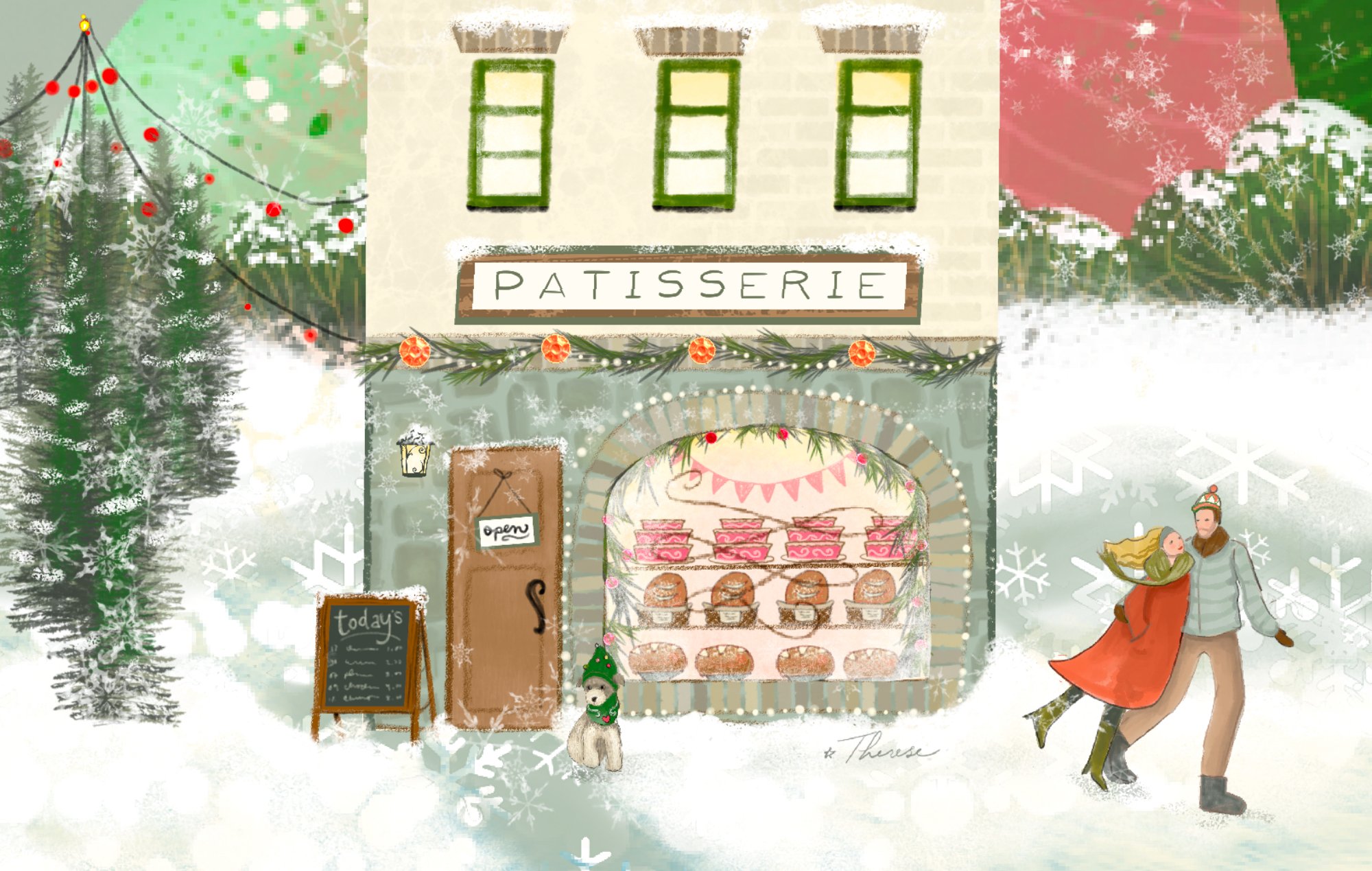
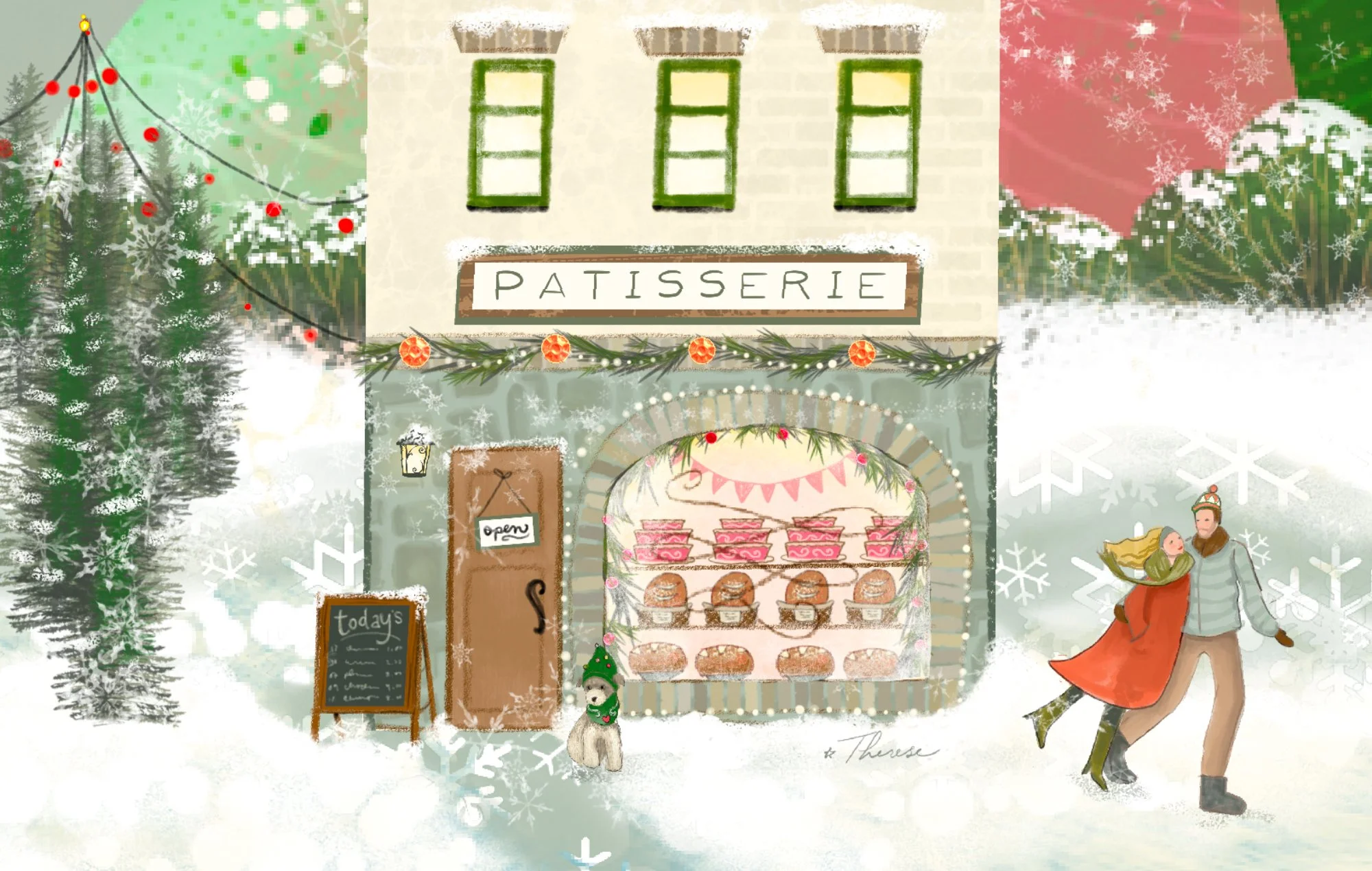
A closeup peak at “Blissful Bakery” by Therese Tucker for the #TinselTown2025 challenge.
Why I’m Building Two Portfolios Instead of Just One
For the longest time, I thought I had to choose.
Was I going to be a children’s book illustrator, or a surface designer?
I’ve always known that my art had a certain magical, whimsical energy. I’ve worked hard to refine my voice, understand my style, and commit to consistent practice. But even with all that effort, I still felt stuck in one major area: what to focus on.
I saw illustrators creating dreamy picture books and imagined my work bringing characters to life on the page. Then I'd see surface designers turning art into fabric, stationery, and home goods and I felt pulled in that direction, too. I felt a deep love for both paths… and a persistent belief that I could only choose one.
Until one day, I came across a YouTube video by Mel Armstrong.
She said something that cracked everything open for me:
"You can absolutely build both portfolios. You don’t have to choose.”
It was such a simple statement, but it blew my mind. Her words gave me permission to do what my intuition had been telling me all along: that my creativity doesn’t need to be confined to one box. It’s okay to walk both paths and let them inform one another.
A Quick Shout-Out to Mel Armstrong
If you’re not familiar with her work, Mel Armstrong is a children’s book illustrator and surface pattern designer with a truly distinctive style. She’s built a creative business around doing both and I just want to say thank you, Mel, for sharing that insight. It helped me find peace, clarity, and direction in what had felt like an overwhelming fork in the road.
My Dual-Path Art Vision
So here’s what I’m working on now:
Path One: Storytelling Illustration
I’m building a portfolio of work that feels like it belongs in a beautiful picture book with pieces that carry emotion, whimsy, narrative, and heart. These characters often arrive intuitively. Sometimes I dream them. Sometimes they speak before they fully appear. I know that this part of my work is deeply tied to my mission: to create art that opens portals, sparks remembrance, and connects the viewer to something deeper.
Path Two: Surface Design
I’m also building collections of repeat patterns, seasonal illustrations, and motif-driven art that could live beautifully on fabric, stationery, wallpaper, home goods, and giftware. This path feels more grounded and product-oriented, and I find joy in the way it allows me to think in terms of collections, utility, and design.
Rather than seeing this as a conflict of direction, I now see it as a spectrum of creativity: two ways that my art can live in the world. And truthfully, many of the artists I admire most do exactly this: they have both a story-driven and a product-driven side to their art business.
Trusting Intuition to Lead the Way
This shift didn’t come from a perfect business plan.
It came from listening inward. From noticing the projects that felt alive. From trusting that what brings joy to me is likely what will resonate most with others.
I’m no longer trying to shove myself into a neat niche or force clarity from the outside in. I’m following what wants to be expressed and honoring the full spectrum of creative expression that flows through me.
That doesn’t mean I won’t be strategic or intentional. I’m still creating two portfolios. I’m still thinking about markets, formats, and licensing. But I’m doing so with a sense of permission. Giving myself permission to build an art career that reflects the multitudes within me.
For the Creatives Who Can’t Pick One Thing
If you’ve ever felt torn between two creative paths, I want you to know:
You don’t have to choose. You can build both. You can find the threads that connect them.
And you can trust that your unique mix of gifts will lead to something beautiful.
I'm using the Epic Year Workshop (my signature yearly planning experience) to help me bring this dual-path dream into form and if you're curious about building a vision for your own creative future, you’re invited to join me.
You can also follow along on Patreon, where I share behind-the-scenes looks at both portfolios as they unfold.
This is a new season of creative alignment for me—and I'm so excited to walk this path.
How to Develop a Growth Mindset as an Artist (And Why It’s More Important Than Talent)
There’s a quiet revolution that happens when an artist shifts from asking, “Am I good enough?” to asking, “How can I grow from this?” That’s the difference a growth mindset can make. In this post, I want to share what this shift looks like in real time: the messy, hopeful, vulnerable truth about creating art when your inner critic is loud, your skills are evolving, and your dreams are huge.
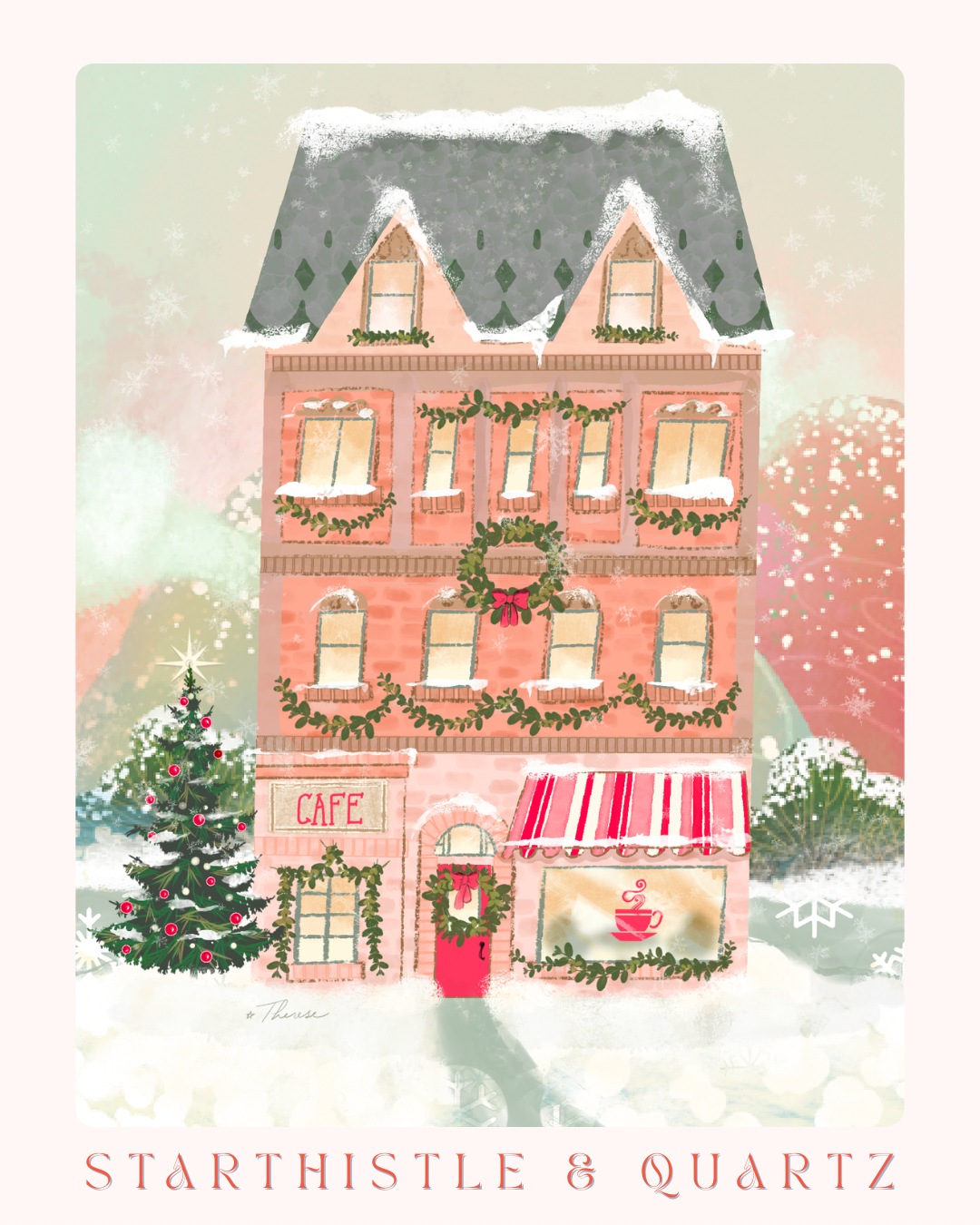
“Cocoa Cafe” by Therese Tucker for #tinseltown2025 challenge.
There’s a quiet revolution that happens when an artist shifts from asking, “Am I good enough?” to asking, “How can I grow from this?” That’s the difference a growth mindset can make. In this post, I want to share what this shift looks like in real time: the messy, hopeful, vulnerable truth about creating art when your inner critic is loud, your skills are evolving, and your dreams are huge.
Whether you're in a season of expansion or frustration, I hope these thoughts will help you reconnect to your creative path and keep walking it with love.
1. What a Growth Mindset Looks Like in Real Life
For me, a growth mindset as an artist means deeply believing that my skills, talents, and voice aren’t fixed. They’re alive and expanding with every brushstroke, sketch, or creative decision I make.
Even when a piece doesn’t turn out how I hoped, I’ve learned to trust that each session sharpens my hand and my eye, and takes me one step closer to the artist I’m becoming.
2. What It Feels Like When I’m Stuck in a Fixed Mindset
Every time my inner critic flares up, I know I’m brushing up against a fixed mindset. It’s that harsh, “reasonable-sounding” voice that tells me my work isn’t good enough, or that someone else’s style or polish means I should just quit trying.
Recently, while working on the #TinselTown2025 challenge, a cozy Christmas village illustration series, my self-doubt came in fast. I love this style of work, but I don’t feel confident in it yet, and my inner critic had a lot to say about how “wrong” it all looked.
Fixed mindset thinking makes you feel like you’re trapped in a box, with only one “right” way to make art. And that’s a lie.
3. How I Shift Back into Growth Mode
When I catch myself spiraling, I remind myself: This is just one piece. It’s not the defining moment of my career. It’s one brushstroke in a much bigger picture.
I also work with my nervous system with a few deep breaths, a body shake, a little movement to get my energy flowing again. I remind myself that moving the body helps move the mind.
Growth lives in motion, not perfection.
4. A Trick That Helps Me Regain Perspective
When things start feeling visually or emotionally “off,” I give myself permission to walk away. Distance softens the critical voice and resets your eyes.
Sometimes, I even invert my body by hanging my head over the edge of the bed upside down or do a stretch to literally shift my view. It sounds simple, but changing how you look at your work helps you feel differently about it too.
5. To the Artist Who’s Feeling Behind…
Have compassion for yourself. You feel this way because you care deeply. That’s a beautiful thing.
If your vision feels far away, know that most dreams are made up of tiny steps, not giant leaps. There are days when I can only sketch for 5 minutes. But that 5 minutes helps me feel my momentum.
If I showed up today, then I’m closer to my dream than I was yesterday. And so are you.
6. Want Support for Your Creative Growth?
If this post resonated, you might love some of the spaces I’ve created to support other sensitive creatives:
🎨 Follow my journey on Patreon — See my collections unfold, get exclusive access to stickers, postcards, behind-the-scenes process, and more.
🌠 Try the free Dream Lab — My guided tool to help you clarify your soul-aligned “North Star” so you can turn big dreams into grounded direction.
🌙 Join the Epic Year Workshop — This workshop turns your soul-aligned dream into a 12-month creative strategy rooted in nervous system alignment, numerology + your progressed moon.
Final Thoughts
You don’t need to be perfect to be powerful. You don’t need to be the most polished to be on your path. You just need to keep showing up.
If you’ve been looking for a sign to keep going — this is it.