
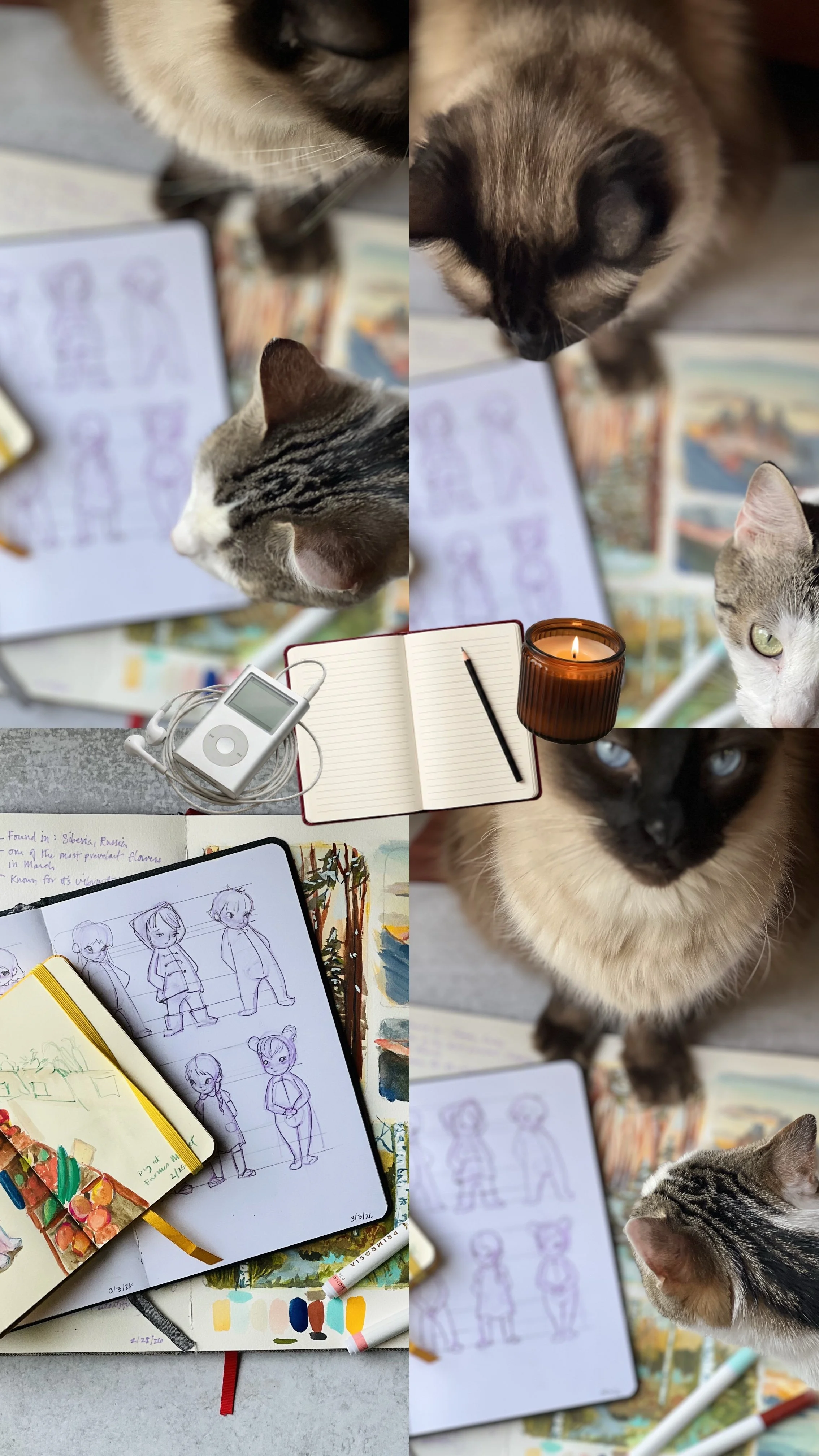
The Sneaky Way Procrastination Shows Up for Creative People (And Why It Has Nothing to Do With Laziness)
I never thought of myself as someone who procrastinates.
Honestly, the word never even applied to me in my mind. I am always doing something. My days are full, my mind is engaged, and I am constantly working on something related to my art. So the idea that I might be avoiding the work? It genuinely never crossed my mind.
Until one morning it did.
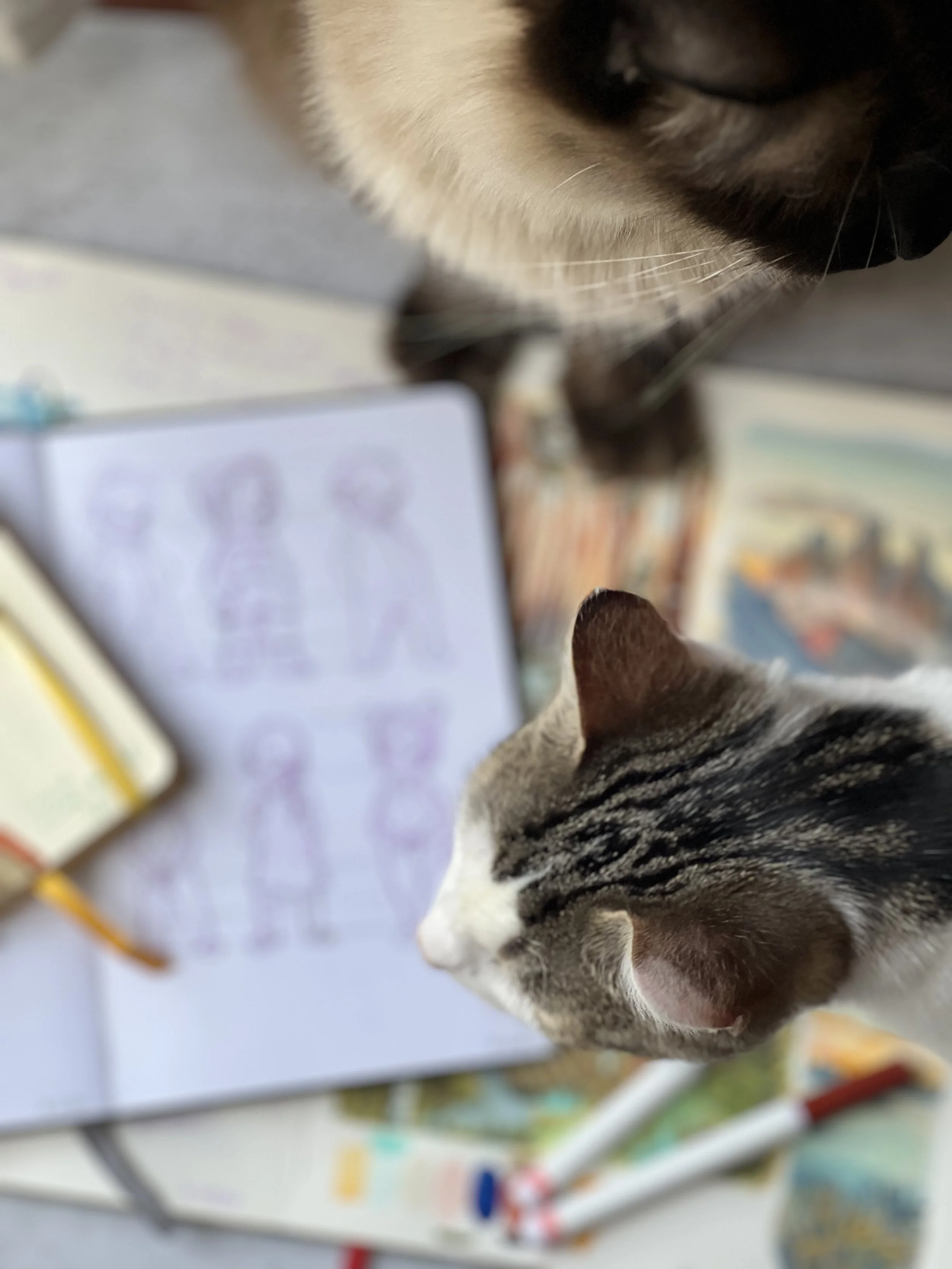
My studio assistants, Skippy & Mia, assessing my busy work.
I never thought of myself as someone who procrastinates.
Honestly, the word never even applied to me in my mind. I am always doing something. My days are full, my mind is engaged, and I am constantly working on something related to my art. So the idea that I might be avoiding the work? It genuinely never crossed my mind.
Until one morning it did.
I sat down to work on facial expressions for a character in my children's book illustration portfolio. I put in what felt like a solid hour of real work. It felt good. I felt productive. And then I stepped away, came back later that day, looked at what I'd made, and immediately hated it.
And that was it. That was the moment the spiral started.
Instead of pushing through, I went into full research paralysis. I started looking at other illustrators, other styles, trying to figure out what I liked more. I went to the bookstore a couple of times and just sat with children's books, making mental notes. And I never went back to the sketchbook. Not because I forgot. Because I felt like I had failed so hard that my own style wasn't good enough to keep going.
What I didn't realize at the time was that this wasn't an off day. This was productive procrastination. And it is so much sneakier than the regular kind.
When Avoiding the Work Looks Like Doing the Work
Here's what productive procrastination looked like for me in practice.
I knew exactly what I needed to add to my children's book portfolio. I knew the kinds of pieces art directors want to see. I had a direction. The next step was clear: sit down and make the pieces.
But instead of doing that, I kept circling around it. I would do practice runs. I would research illustration styles. I would find a class to take, and then while taking that class I would realize I needed to work on color values, so I would find a class on that. Then I would decide my light and shadow work needed improvement digitally, so I would look for a class on that too.
Every single step felt important. Every step felt like growth.
But at the end of the week, the portfolio pieces still didn't exist.
I was moving constantly. Just not forward.
And on top of that, I was also trying to build a surface design portfolio at the same time, because that also felt important and like it was going to lead somewhere. So now I had two directions pulling at me, and I was making very little real progress in either one.
Hamster wheel. Lots of motion, almost no traction.
The Fear Underneath the Busyness
When I finally sat down and journaled about what was actually happening, something uncomfortable became very clear.
My procrastination isn't laziness. It's perfectionism. And underneath the perfectionism is fear.
Here's the specific fear, the one I hadn't quite named yet: right now, I can hide behind an excuse. I've already been submitting myself for children's illustration work, and when I don't hear back, I can tell myself it's because my portfolio isn't quite presenting what art directors are looking for yet. That excuse is actually a comfort. It gives me somewhere to put the rejection that isn't about me.
But the moment I build the portfolio I know they want to see, the moment I truly put my best work forward, I lose that excuse. And then the answer becomes real. What if I do everything right, and they still don't hire me?
That is a vulnerable place to stand.
And so instead of standing there, I kept refining. I kept preparing. I kept waiting to be ready, even though "ready" didn't have a name or a face or a finish line. It was just this vague feeling of not good enough yet, and I kept chasing it.
The Moment I Caught Myself
What finally broke the cycle was journaling.
When I sat down and wrote honestly about what I had been doing with my time, it became very clear very fast. I could see the difference between real work and work that mimics real work. Research can look like progress. Classes can look like progress. Practice runs can look like progress. But at some point you have to stop preparing and start producing.
And what I saw in my journal was that I had been letting my inner critic decide when I was allowed to move forward. I was waiting for her to give me permission to be good enough, and she was never going to give it to me.
That realization landed hard. And it moved me immediately.
What I Do Once I See It
Once I recognize I'm in productive procrastination mode, I do two things right away.
First, I give myself a specific deadline. Not "sometime soon" but an actual date.
Second, I narrow the task down to one clear, concrete action. Not "work on my portfolio" but something like "create one piece showing character interaction in a children's book scene." That kind of specificity breaks the spell. The resistance starts to dissolve because the task is no longer this big shapeless scary thing. It's just one thing.
And I move into it.
One Question That Always Helps Me Reset
When I catch myself spinning in preparation mode, I ask myself this:
What is the real work I am avoiding right now?
Not the practice. Not the research. Not the preparation. The real work.
And once I answer that honestly, I always know exactly what to do next.
If this resonates with you, if you've been feeling busy but somehow stuck, you might not be procrastinating the way you think. You might just be circling the work you care about most. And that makes a lot of sense, because the work that matters most to us is also the work that makes us the most vulnerable.
You're not behind. You're not lazy. You might just be waiting for permission that only you can give yourself.
If You Want to Watch the Shaping in Real Time
I share this whole stage inside my Patreon, the works in progress, the portfolio building, the experimenting, the refining. It's not polished. It's honest. And if you're building something too, I think you'd feel right at home there.
And if you're feeling lost in the woods right now and need help reconnecting with your North Star, the Starlight Dream Lab is a beautiful place to begin. It's where we do the deeper work of remembering what you're actually building toward.
Keep going, beautiful soul.
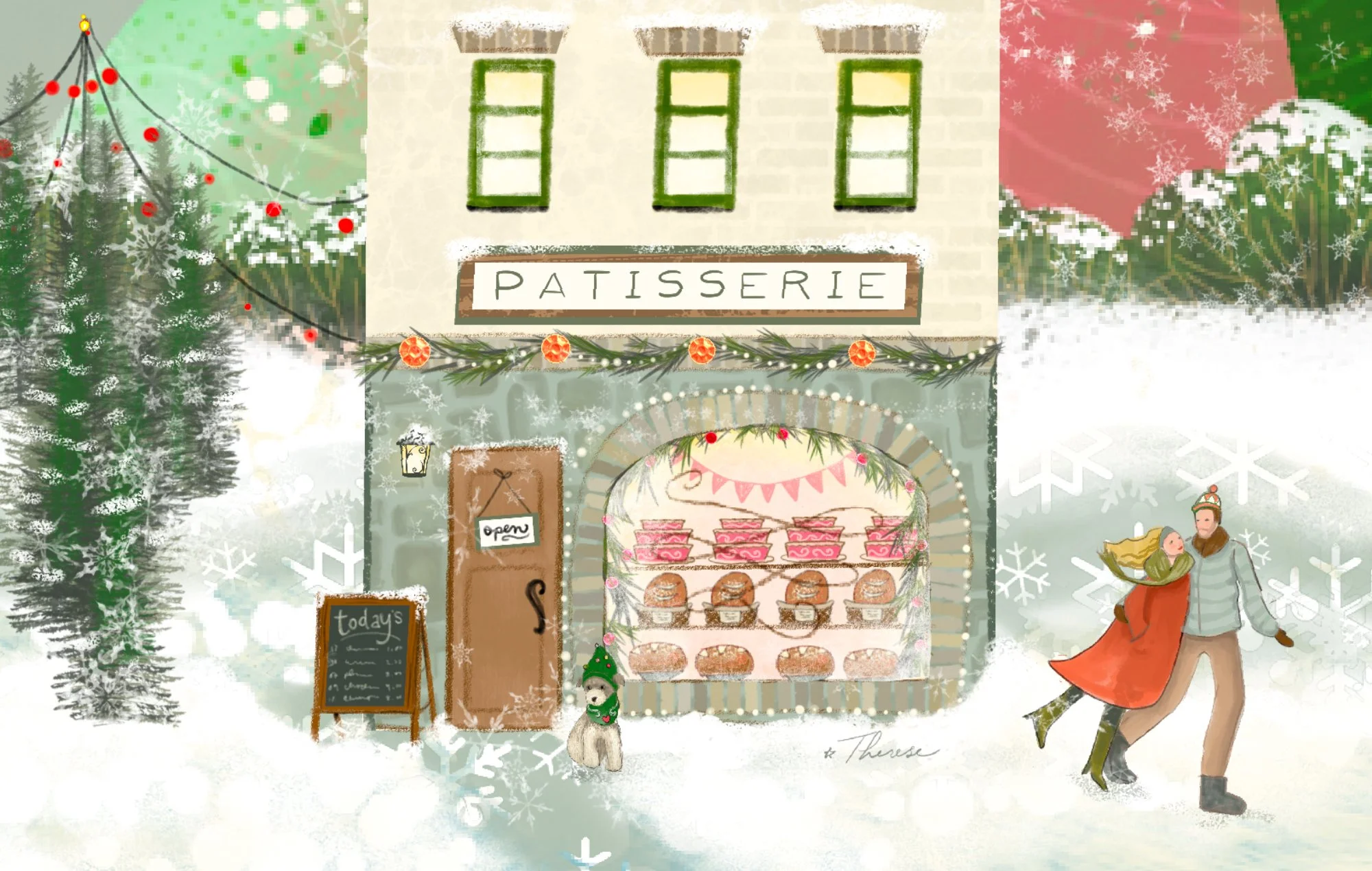
Walking Two Creative Paths: Storytelling & Surface Design
For the longest time, I thought I had to choose.
Was I going to be a children’s book illustrator—or a surface designer?
I’ve always known that my art had a certain magical, whimsical energy. I’ve worked hard to refine my voice, understand my style, and commit to consistent practice. But even with all that effort, I still felt stuck in one major area: what to focus on.
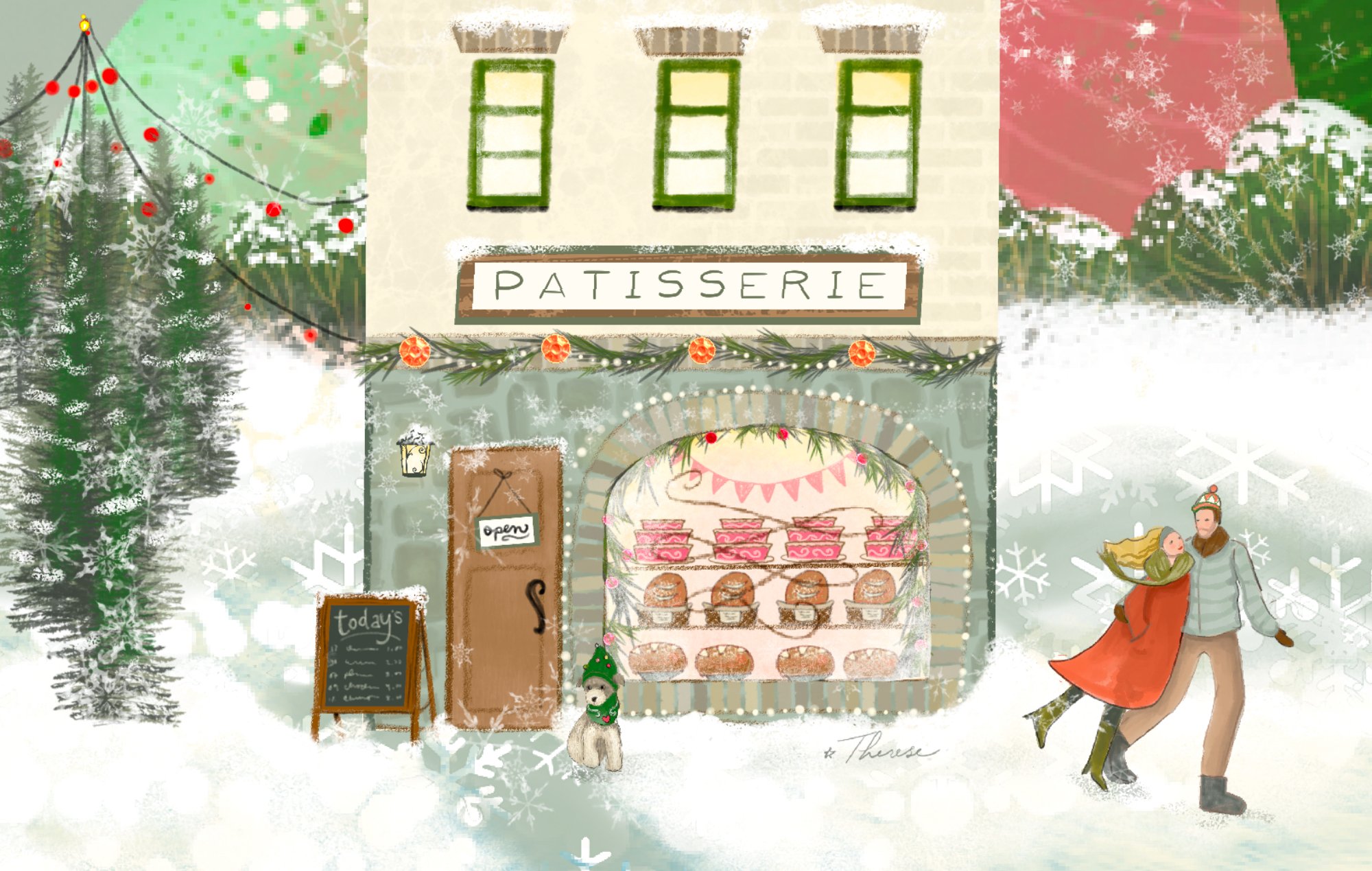
A closeup peak at “Blissful Bakery” by Therese Tucker for the #TinselTown2025 challenge.
Why I’m Building Two Portfolios Instead of Just One
For the longest time, I thought I had to choose.
Was I going to be a children’s book illustrator, or a surface designer?
I’ve always known that my art had a certain magical, whimsical energy. I’ve worked hard to refine my voice, understand my style, and commit to consistent practice. But even with all that effort, I still felt stuck in one major area: what to focus on.
I saw illustrators creating dreamy picture books and imagined my work bringing characters to life on the page. Then I'd see surface designers turning art into fabric, stationery, and home goods and I felt pulled in that direction, too. I felt a deep love for both paths… and a persistent belief that I could only choose one.
Until one day, I came across a YouTube video by Mel Armstrong.
She said something that cracked everything open for me:
"You can absolutely build both portfolios. You don’t have to choose.”
It was such a simple statement, but it blew my mind. Her words gave me permission to do what my intuition had been telling me all along: that my creativity doesn’t need to be confined to one box. It’s okay to walk both paths and let them inform one another.
A Quick Shout-Out to Mel Armstrong
If you’re not familiar with her work, Mel Armstrong is a children’s book illustrator and surface pattern designer with a truly distinctive style. She’s built a creative business around doing both and I just want to say thank you, Mel, for sharing that insight. It helped me find peace, clarity, and direction in what had felt like an overwhelming fork in the road.
My Dual-Path Art Vision
So here’s what I’m working on now:
Path One: Storytelling Illustration
I’m building a portfolio of work that feels like it belongs in a beautiful picture book with pieces that carry emotion, whimsy, narrative, and heart. These characters often arrive intuitively. Sometimes I dream them. Sometimes they speak before they fully appear. I know that this part of my work is deeply tied to my mission: to create art that opens portals, sparks remembrance, and connects the viewer to something deeper.
Path Two: Surface Design
I’m also building collections of repeat patterns, seasonal illustrations, and motif-driven art that could live beautifully on fabric, stationery, wallpaper, home goods, and giftware. This path feels more grounded and product-oriented, and I find joy in the way it allows me to think in terms of collections, utility, and design.
Rather than seeing this as a conflict of direction, I now see it as a spectrum of creativity: two ways that my art can live in the world. And truthfully, many of the artists I admire most do exactly this: they have both a story-driven and a product-driven side to their art business.
Trusting Intuition to Lead the Way
This shift didn’t come from a perfect business plan.
It came from listening inward. From noticing the projects that felt alive. From trusting that what brings joy to me is likely what will resonate most with others.
I’m no longer trying to shove myself into a neat niche or force clarity from the outside in. I’m following what wants to be expressed and honoring the full spectrum of creative expression that flows through me.
That doesn’t mean I won’t be strategic or intentional. I’m still creating two portfolios. I’m still thinking about markets, formats, and licensing. But I’m doing so with a sense of permission. Giving myself permission to build an art career that reflects the multitudes within me.
For the Creatives Who Can’t Pick One Thing
If you’ve ever felt torn between two creative paths, I want you to know:
You don’t have to choose. You can build both. You can find the threads that connect them.
And you can trust that your unique mix of gifts will lead to something beautiful.
I'm using the Epic Year Workshop (my signature yearly planning experience) to help me bring this dual-path dream into form and if you're curious about building a vision for your own creative future, you’re invited to join me.
You can also follow along on Patreon, where I share behind-the-scenes looks at both portfolios as they unfold.
This is a new season of creative alignment for me—and I'm so excited to walk this path.