
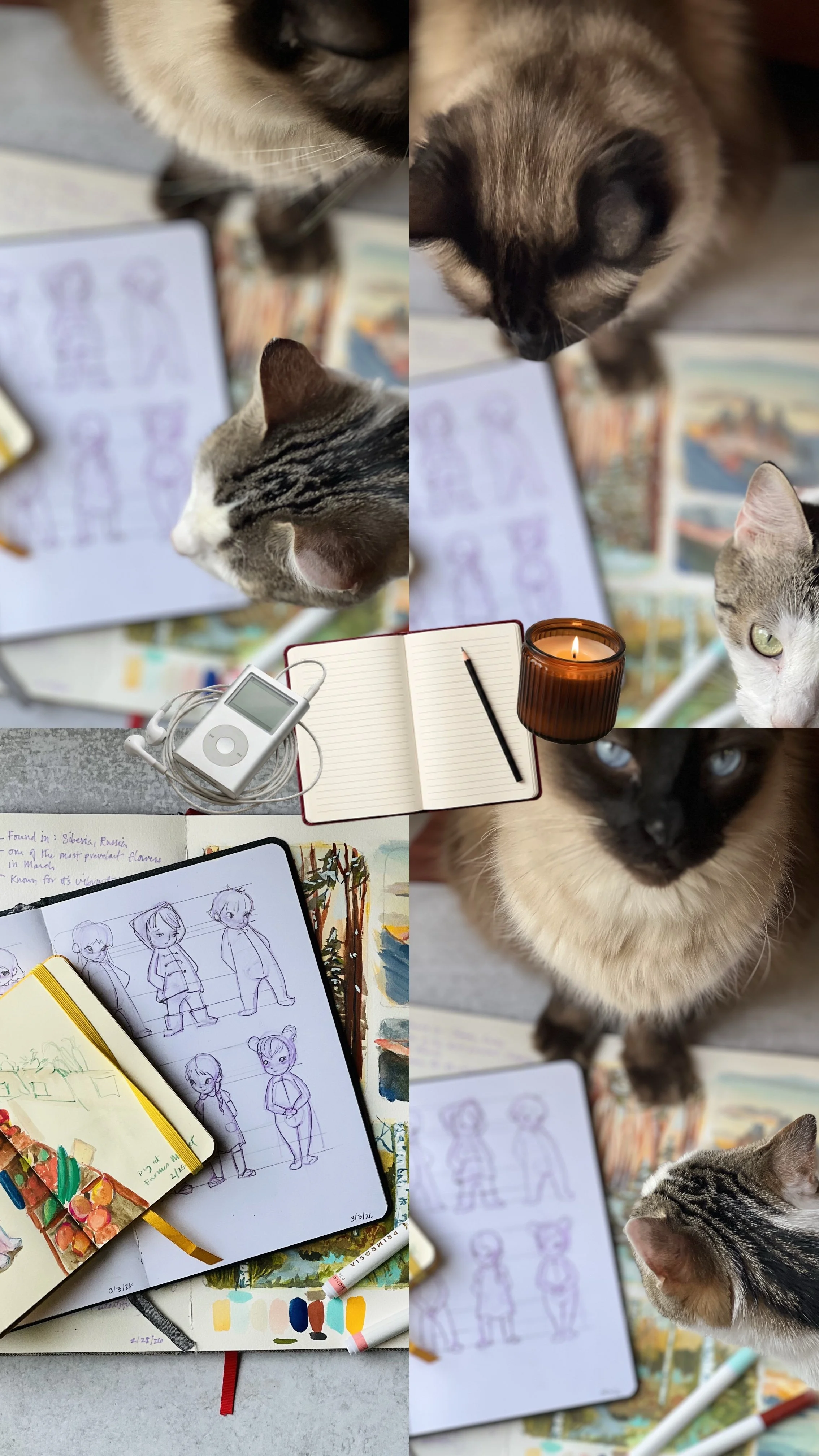
The Sneaky Way Procrastination Shows Up for Creative People (And Why It Has Nothing to Do With Laziness)
I never thought of myself as someone who procrastinates.
Honestly, the word never even applied to me in my mind. I am always doing something. My days are full, my mind is engaged, and I am constantly working on something related to my art. So the idea that I might be avoiding the work? It genuinely never crossed my mind.
Until one morning it did.
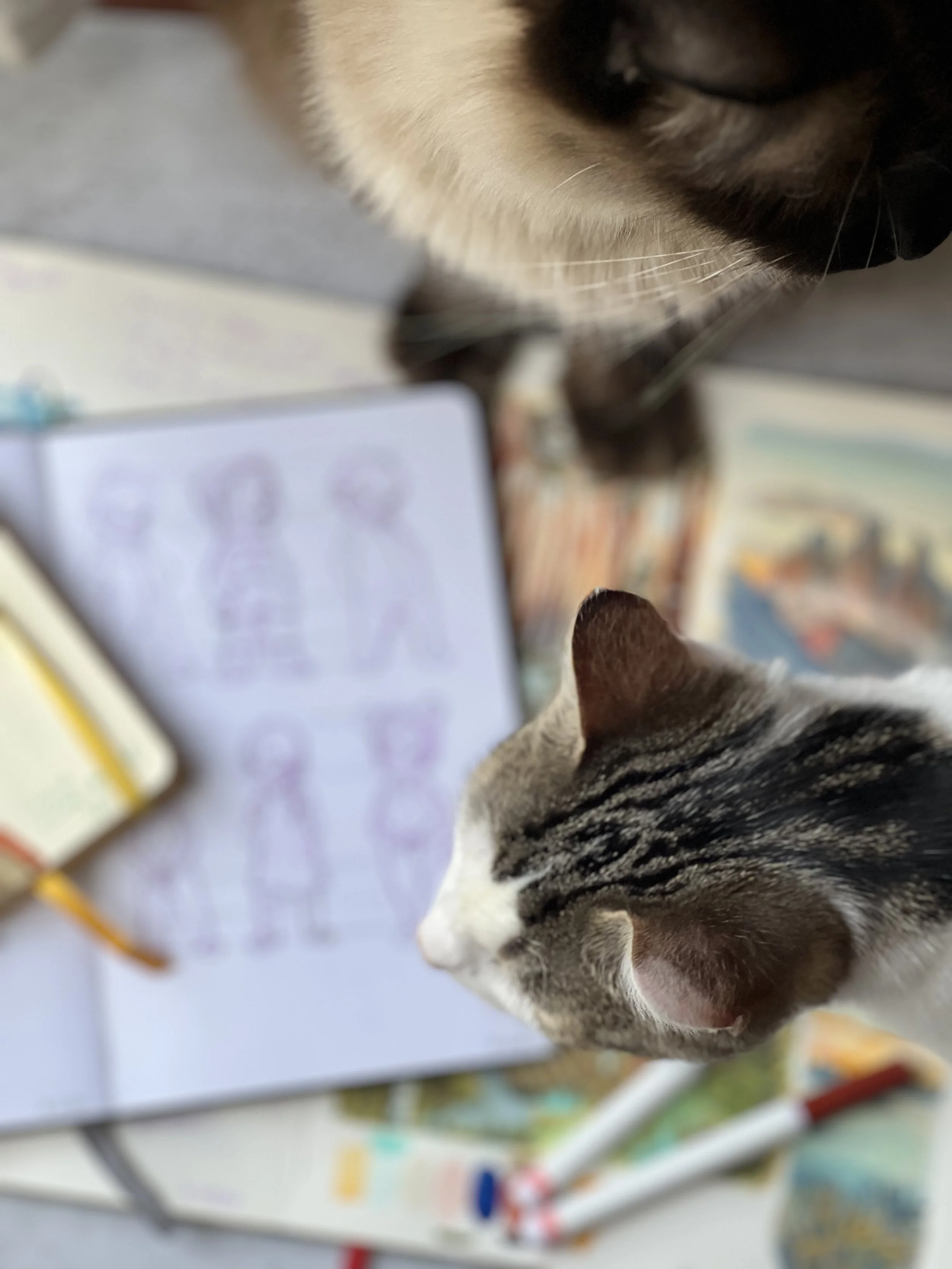
My studio assistants, Skippy & Mia, assessing my busy work.
I never thought of myself as someone who procrastinates.
Honestly, the word never even applied to me in my mind. I am always doing something. My days are full, my mind is engaged, and I am constantly working on something related to my art. So the idea that I might be avoiding the work? It genuinely never crossed my mind.
Until one morning it did.
I sat down to work on facial expressions for a character in my children's book illustration portfolio. I put in what felt like a solid hour of real work. It felt good. I felt productive. And then I stepped away, came back later that day, looked at what I'd made, and immediately hated it.
And that was it. That was the moment the spiral started.
Instead of pushing through, I went into full research paralysis. I started looking at other illustrators, other styles, trying to figure out what I liked more. I went to the bookstore a couple of times and just sat with children's books, making mental notes. And I never went back to the sketchbook. Not because I forgot. Because I felt like I had failed so hard that my own style wasn't good enough to keep going.
What I didn't realize at the time was that this wasn't an off day. This was productive procrastination. And it is so much sneakier than the regular kind.
When Avoiding the Work Looks Like Doing the Work
Here's what productive procrastination looked like for me in practice.
I knew exactly what I needed to add to my children's book portfolio. I knew the kinds of pieces art directors want to see. I had a direction. The next step was clear: sit down and make the pieces.
But instead of doing that, I kept circling around it. I would do practice runs. I would research illustration styles. I would find a class to take, and then while taking that class I would realize I needed to work on color values, so I would find a class on that. Then I would decide my light and shadow work needed improvement digitally, so I would look for a class on that too.
Every single step felt important. Every step felt like growth.
But at the end of the week, the portfolio pieces still didn't exist.
I was moving constantly. Just not forward.
And on top of that, I was also trying to build a surface design portfolio at the same time, because that also felt important and like it was going to lead somewhere. So now I had two directions pulling at me, and I was making very little real progress in either one.
Hamster wheel. Lots of motion, almost no traction.
The Fear Underneath the Busyness
When I finally sat down and journaled about what was actually happening, something uncomfortable became very clear.
My procrastination isn't laziness. It's perfectionism. And underneath the perfectionism is fear.
Here's the specific fear, the one I hadn't quite named yet: right now, I can hide behind an excuse. I've already been submitting myself for children's illustration work, and when I don't hear back, I can tell myself it's because my portfolio isn't quite presenting what art directors are looking for yet. That excuse is actually a comfort. It gives me somewhere to put the rejection that isn't about me.
But the moment I build the portfolio I know they want to see, the moment I truly put my best work forward, I lose that excuse. And then the answer becomes real. What if I do everything right, and they still don't hire me?
That is a vulnerable place to stand.
And so instead of standing there, I kept refining. I kept preparing. I kept waiting to be ready, even though "ready" didn't have a name or a face or a finish line. It was just this vague feeling of not good enough yet, and I kept chasing it.
The Moment I Caught Myself
What finally broke the cycle was journaling.
When I sat down and wrote honestly about what I had been doing with my time, it became very clear very fast. I could see the difference between real work and work that mimics real work. Research can look like progress. Classes can look like progress. Practice runs can look like progress. But at some point you have to stop preparing and start producing.
And what I saw in my journal was that I had been letting my inner critic decide when I was allowed to move forward. I was waiting for her to give me permission to be good enough, and she was never going to give it to me.
That realization landed hard. And it moved me immediately.
What I Do Once I See It
Once I recognize I'm in productive procrastination mode, I do two things right away.
First, I give myself a specific deadline. Not "sometime soon" but an actual date.
Second, I narrow the task down to one clear, concrete action. Not "work on my portfolio" but something like "create one piece showing character interaction in a children's book scene." That kind of specificity breaks the spell. The resistance starts to dissolve because the task is no longer this big shapeless scary thing. It's just one thing.
And I move into it.
One Question That Always Helps Me Reset
When I catch myself spinning in preparation mode, I ask myself this:
What is the real work I am avoiding right now?
Not the practice. Not the research. Not the preparation. The real work.
And once I answer that honestly, I always know exactly what to do next.
If this resonates with you, if you've been feeling busy but somehow stuck, you might not be procrastinating the way you think. You might just be circling the work you care about most. And that makes a lot of sense, because the work that matters most to us is also the work that makes us the most vulnerable.
You're not behind. You're not lazy. You might just be waiting for permission that only you can give yourself.
If You Want to Watch the Shaping in Real Time
I share this whole stage inside my Patreon, the works in progress, the portfolio building, the experimenting, the refining. It's not polished. It's honest. And if you're building something too, I think you'd feel right at home there.
And if you're feeling lost in the woods right now and need help reconnecting with your North Star, the Starlight Dream Lab is a beautiful place to begin. It's where we do the deeper work of remembering what you're actually building toward.
Keep going, beautiful soul.
Why Trusting Your Art Process Is So Hard (And What to Do When You Can't See the Outcome Yet)
This week, I ruined a painting. Or at least, that's what it felt like in the moment.
I was working on an owl butterfly hybrid, a barn owl face painted over India ink, with washes of watercolor and gouache layered on top. The ink is my base layer. It's a process I love. And then, right in the middle of the face (which is supposed to be almost white, the way barn owls are), a big splash of black ink landed exactly where I didn't want it.
See? You would never know that I dripped ink all over his face!
This week, I ruined a painting. Or at least, that's what it felt like in the moment.
I was working on an owl butterfly hybrid, a barn owl face painted over India ink, with washes of watercolor and gouache layered on top. The ink is my base layer. It's a process I love. And then, right in the middle of the face (which is supposed to be almost white, the way barn owls are), a big splash of black ink landed exactly where I didn't want it.
I couldn't wipe it up. India ink is immediate and permanent on paper. So I had to make a choice: panic, tear the page out, start over, or trust the process and keep going.
I kept going. I filled in the rest of the face with the dark ink, reminded myself that gouache is opaque (it can cover anything), and decided to see what happened.
What happened is that it became one of the moodiest, most atmospheric pieces I've made. The dark underlayer gave it depth. It enhanced the evening feeling I was going for, something I couldn't have planned if I tried.
But here's the thing: I could only trust the process because I knew something. I knew gouache could cover it. I knew the ink would add depth. I had enough experience to take the leap.
What do you do when you don't have that certainty? What do you do when you're in the middle and you genuinely cannot predict the outcome?
The Middle Is Genuinely Unpredictable (And That's Not a Personal Flaw)
I want to be honest with you about something, because I think a lot of artist advice glosses over this part: trusting the process doesn't mean you know how it ends. It means you stay in it anyway, without that guarantee.
Right now, I'm working toward licensing my artwork. And there are weeks where I feel completely aligned, clear on my direction, energized, confident. And then there are weeks where I'm scrolling, comparing, questioning whether any of this is actually going anywhere.
The thought that lands hardest during those doubt-weeks isn't loud or dramatic. It's quiet and it sounds educated. It sounds like: what if no one wants this? What if I can't actually make a living doing this?
That thought brings exhaustion with it. And the exhaustion can start to feel like a signal, like maybe it's your nervous system telling you something is wrong. But I've started to wonder if exhaustion in the middle might actually be a sign that you are working toward something real. Something that matters enough to scare you.
What "Trusting the Process" Actually Requires
I used to think trusting the process was a mindset thing, like if I believed hard enough, the doubt would go away. It doesn't work like that, at least not for me.
What I've found is that trust isn't the absence of doubt. It's showing up in the presence of it.
With my painting, I trusted the process because I had a technical foundation to lean on. I knew what gouache could do. In the bigger picture of building a creative career, the equivalent of that technical foundation is consistency. Every day I show up and make something, I'm adding to what I know. I'm sharpening my eye. I'm expanding what I'm capable of. I'm building a body of work that compounds over time.
The process only works if you stay in it long enough for it to work. And staying in it is the hard part, especially when you are squarely in the middle and the outcome is genuinely unknown.
Rejection as Direction, Not Verdict
Something has shifted in me around rejection lately. It doesn't feel as final as it used to.
A "no" tells me something. It makes me look closer at my work. It makes me tighten, refine, and adjust. It's uncomfortable, genuinely uncomfortable, but it's also useful information. Like the splash of black ink: it doesn't mean the painting is ruined. It means I have to find a new way through.
I think the artists who make it are not the ones who avoid rejection. They're the ones who learn to read it differently. Not as a verdict on their worth, but as a signal about direction.
When You Feel Like You've Ruined Everything: A Practical Reset
When I hit that moment in a painting where I'm sure I've destroyed it, I've learned to do one thing: walk away. Sometimes I move to another piece. Sometimes I sleep on it. And almost always, when I come back with fresh eyes, I can see the path forward.
The "ruin" is almost never actual ruin. It's usually over-focus. It's my brain being too close to the work for too long.
The same is true in bigger creative seasons. If you're feeling like everything is falling apart or stalling out, it's worth asking: when did I last actually step back? Not quit, just breathe. Reset your nervous system. Come back with distance.
Exhaustion can masquerade as failure. Confusion can masquerade as incompetence. Give yourself the chance to tell the difference before you make any decisions about stopping.
If You're in the Middle Right Now
If you're applying and hearing nothing back. If you're creating consistently but can't see the traction yet. If you're doubting whether your work is good enough, or whether you started too late, or whether anyone actually wants what you're making, I want to say this clearly:
The middle is supposed to feel like this. It is not a sign you are doing it wrong.
You cannot see the outcome from inside the process. That's not a flaw in you, it's just the nature of the middle. The barn owl face was solid black before it was a moody, atmospheric painting. You can't always know what something is becoming while it's still being made.
What I know is that I'm still here. Still painting, still applying, still refining, still showing up on the days when I can't see where it's going. And I believe, genuinely, that the showing up is what builds the path. Not before you walk it. While you walk it.
Keep going, beautiful soul.
If You Want to Watch the Shaping in Real Time
I share this whole stage inside my Patreon, the works in progress, the portfolio building, the experimenting, the refining. It's not polished. It's honest. And if you're building something too, I think you'd feel right at home there.
And if you're feeling lost in the woods right now and need help reconnecting with your North Star, the Starlight Dream Lab is a beautiful place to begin. It's where we do the deeper work of remembering what you're actually building toward.
How to Find Your Art Style When You Like Too Many Things
If you’ve ever thought, “I like too many things, I’ll never find my art style,” I want you to take a breath right now.
Because what if the problem isn’t that you like too many things…
What if the problem is that you’ve been taught the wrong order?
For a long time, I believed I needed to figure out my style first before I could put myself out into the world as an artist. Before I could show my work. Before I could pursue licensing, illustration, or meaningful opportunities.
And without realizing it, finding my style became a barrier between me and actually doing the work.
That belief quietly feeds perfectionism.
It delays momentum.
And it keeps artists endlessly “preparing” instead of participating.
If that sounds familiar, this post is for you.
(And Why Liking Many Things Is Not the Problem)

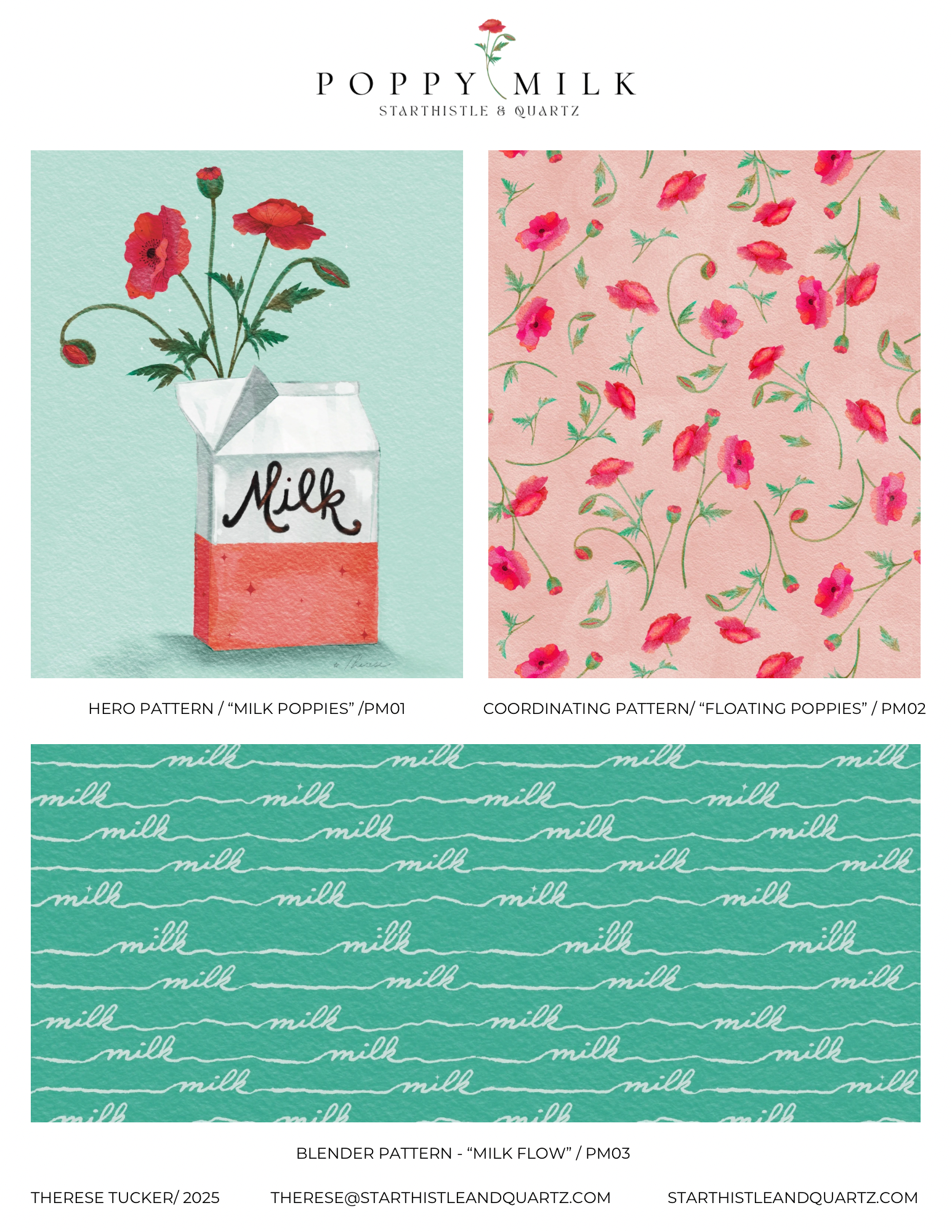
My “Poppy Milk” mini collection from 2025
If you’ve ever thought, “I like too many things , I guess I’ll never find my art style,” I want you to take a breath right now.
Because what if the problem isn’t that you like too many things…
What if the problem is that you’ve been taught the wrong order?
For a long time, I believed I needed to figure out my style first before I could put myself out into the world as an artist. Before I could show my work. Before I could pursue licensing, illustration, or meaningful opportunities.
And without realizing it, finding my style became a barrier between me and actually doing the work.
That belief quietly feeds perfectionism.
It delays momentum.
And it keeps artists endlessly “preparing” instead of participating.
If that sounds familiar, this post is for you.
When “Finding Your Style” Becomes a Trap
Here’s something I don’t hear talked about enough:
A huge part of discovering your style doesn’t happen in private.
It happens after you put your work out into the world.
It happens when:
You notice which pieces people respond to (and which they don’t)
You feel into what doesn’t feel aligned anymore
You receive feedback, even neutral or confusing feedback
You realize what’s missing from your portfolio
You see patterns in what you keep returning to
You can’t get that information by waiting until everything feels perfect.
And yet, many artists treat style like a gatekeeper:
“Once I figure this out, then I’ll be ready.”
In my experience, it’s the opposite.
Readiness comes from repetition, exposure, and choice, not certainty.
Liking Many Things Doesn’t Mean You’re Unfocused
For a long time, I interpreted my wide range of interests as a flaw.
I love:
Gouache and mixed media
Digital illustration and surface design
Animals, women, florals
Mythical, whimsical, storybook worlds
Minimal, chic aesthetics and rich, narrative depth
Children’s books and licensing art for everyday objects
At one point, all of that felt like evidence that I lacked direction.
Now I see it differently.
Liking many things usually means:
You have a wide field of vision
You’re sensitive to nuance
You’re capable of world-building, not just one-off images
You’re meant to work relationally, not narrowly
It doesn’t mean you lack direction.
It means you need cohesion, not restriction.
The Shift That Changed Everything: Working in Collections
The biggest breakthrough in my creative process came when I stopped asking:
“What is my style?”
And started asking:
“What story am I telling, and how can these pieces belong together?”
Working in collections changed everything.
Before that, I created mostly one-off pieces:
Intuitive bursts of inspiration
Beautiful moments, but disconnected
Little momentum
No clear throughline for my audience (or myself)
Once I began working in collections, clarity followed naturally.
Not because I forced a style, but because I made consistent choices.
My Current Framework (You Can Borrow This)
Here’s the simple framework I use now:
Theme → Constraints → Story → Exploration
Instead of waiting for inspiration to strike perfectly, I begin with structure that still allows play.
1. Start with a Theme
This might be:
A place (the woods, a village, the night)
A concept (time of day, seasons, mythology)
A feeling (quiet magic, nostalgia, wonder)
Right now, my Patreon collection Moonrise Menagerie is built around woodland settings, mythic animals, and the progression of time across a single day.
2. Add Constraints (This Is Where Style Begins)
Constraints reduce pressure and increase cohesion.
The things I consciously limit:
Color palette (this is always my doorway in)
Location or setting
Tools & materials (very limited brushes or media)
Motifs (animals, flowers, stars, repeated symbols)
Texture & line weight
When you remove infinite options, your preferences start to speak.
3. Let the Story Lead
Instead of asking, “Am I good enough?”
I ask, “What am I trying to give?”
That shift moves the focus:
Away from self-judgment
Toward connection
Toward the viewer’s experience
Story creates momentum. Style follows.
4. Keep Composition Flexible
I intentionally leave room for play.
I might have a loose idea, but I allow:
Accidents
Discoveries
Adjustments mid-process
Some of my strongest moments happen because I didn’t over-plan.
Why This Quietly Teaches You Your Style
Style isn’t a single decision.
It’s the accumulation of small preferences repeated consistently.
Over time, I noticed:
I reach for the same tools because my hand responds well to them
I layer color in a specific order
I return to warmth, softness, and gentle symbolism
Stars, woodland elements, and nurturing tones appear again and again
I didn’t force these choices.
They emerged because I stayed with the work longer.
That’s the real secret.
What Changed Emotionally When I Stopped “Picking the Right Thing”
I became:
More relaxed
More confident
Less afraid of feedback
More willing to share imperfect work
Feedback became a friend, not a threat.
A “no” stopped feeling like rejection and started feeling like information.
And information builds discernment.
If You Love Too Many Things, Try This This Week
Here are a few gentle, practical starting points:
✨ Option 1: Split the Playground
Give each style its own container:
One sketchbook for minimalist/decorative work
One sketchbook for story-driven illustration
Let each space be cohesive on its own.
✨ Option 2: Repeat One Subject Three Times
Draw the same subject:
In three styles
Or with three color palettes
Or using three tools
Notice which version feels the most alive in your body.
✨ Option 3: Stay With One Piece Longer
Instead of starting something new:
Recreate it again
Adjust one variable
Refine, don’t abandon
Repetition builds confidence faster than novelty.
Style Is a Byproduct, Not the Starting Point
If there’s one thing I want you to remember, it’s this:
Style comes from consistent choices made in motion, not from waiting until you feel ready.
You don’t need to choose one love.
You need to choose a container.
And then let your preferences reveal themselves.
Want to Watch This Process Unfold in Real Time?
Inside my Patreon, I’m currently building an ongoing collection called Moonrise Menagerie: a year-long series exploring woodland worlds, mythic animals, and the subtle magic of time passing.
If you join before the end of February, you’ll receive:
The February postcard and/or sticker
Behind-the-scenes process
How I make cohesive choices without forcing style
If you love woods, magic, and watching a world come together piece by piece, you’ll feel right at home.

When the Collection Finds You
Every October, the art world lights up with prompt challenges. From #Inktober to #Peachtober to smaller niche lists, the community energy is high—and this year, I joined the #ScaryandSweet2025 challenge on Instagram (hosted by @roymeister, @heathermuellerdesign, @heyalissandra, @jenprocreates, and @jessmillerdraws). I entered with one small intention: use a single color palette for the month.
Meet “Knives Meow” from my Scary + Sweet Collection.
Reflections on unexpected inspiration, “ugly” sketchbooks, and letting the art take the lead
Every October, the art world lights up with prompt challenges. From #Inktober to #Peachtober to smaller niche lists, the community energy is high—and this year, I joined the #ScaryandSweet2025 challenge on Instagram (hosted by @roymeister, @heathermuellerdesign, @heyalissandra, @jenprocreates, and @jessmillerdraws). I entered with one small intention: use a single color palette for the month.
That’s it. No plan, no vision, just show up and make art.
And then… something happened.
After creating my first prompt piece ("sweet + sharp"—a kitten baring its claws, framed in Victorian wallpaper), I took a totally different approach with my second. It fell flat. It didn’t feel like me. So I reworked it using the same structure as the first—and suddenly, something clicked.
A collection had quietly started forming without my permission.


Every piece since then has followed the same loose format: a wallpapered background, a central frame, and a character. Each one rooted in the theme of the prompt, but shaped more by feeling than logic. I’m not even usually drawn to spooky or Halloween-inspired art, but working with these themes has given me more creative freedom than I expected. I’m chasing texture. I’m sketching in a deliberately “ugly” sketchbook. I’m letting go.
And more than anything—I’m letting the art tell me what it wants to become.
Growing Out Loud
There’s something awkward about evolving your style in public. I look back on old work and sometimes feel disconnected. Some pieces still feel true. Others feel like echoes of another artist—or like I was just following a tutorial. There’s pride, sure, but there’s also cringey vulnerability.
Still—I’m glad I kept sharing.
I believe art that truly moves people doesn’t come from strategy. It comes from surrender. From being the channel. When you let go of the outcome and simply prepare the space—your art will meet you there.
💌 Want to See the Collection?
You can view the first 5 pieces of this evolving series over on Instagram at @starthistle.and.quartz. Want to help me vote on which piece becomes the October Patreon reward? Come join me on Patreon where this collection is unfolding in real time—postcards, stickers, and behind-the-scenes process videos included.