
Why Trusting Your Art Process Is So Hard (And What to Do When You Can't See the Outcome Yet)
This week, I ruined a painting. Or at least, that's what it felt like in the moment.
I was working on an owl butterfly hybrid, a barn owl face painted over India ink, with washes of watercolor and gouache layered on top. The ink is my base layer. It's a process I love. And then, right in the middle of the face (which is supposed to be almost white, the way barn owls are), a big splash of black ink landed exactly where I didn't want it.
See? You would never know that I dripped ink all over his face!
This week, I ruined a painting. Or at least, that's what it felt like in the moment.
I was working on an owl butterfly hybrid, a barn owl face painted over India ink, with washes of watercolor and gouache layered on top. The ink is my base layer. It's a process I love. And then, right in the middle of the face (which is supposed to be almost white, the way barn owls are), a big splash of black ink landed exactly where I didn't want it.
I couldn't wipe it up. India ink is immediate and permanent on paper. So I had to make a choice: panic, tear the page out, start over, or trust the process and keep going.
I kept going. I filled in the rest of the face with the dark ink, reminded myself that gouache is opaque (it can cover anything), and decided to see what happened.
What happened is that it became one of the moodiest, most atmospheric pieces I've made. The dark underlayer gave it depth. It enhanced the evening feeling I was going for, something I couldn't have planned if I tried.
But here's the thing: I could only trust the process because I knew something. I knew gouache could cover it. I knew the ink would add depth. I had enough experience to take the leap.
What do you do when you don't have that certainty? What do you do when you're in the middle and you genuinely cannot predict the outcome?
The Middle Is Genuinely Unpredictable (And That's Not a Personal Flaw)
I want to be honest with you about something, because I think a lot of artist advice glosses over this part: trusting the process doesn't mean you know how it ends. It means you stay in it anyway, without that guarantee.
Right now, I'm working toward licensing my artwork. And there are weeks where I feel completely aligned, clear on my direction, energized, confident. And then there are weeks where I'm scrolling, comparing, questioning whether any of this is actually going anywhere.
The thought that lands hardest during those doubt-weeks isn't loud or dramatic. It's quiet and it sounds educated. It sounds like: what if no one wants this? What if I can't actually make a living doing this?
That thought brings exhaustion with it. And the exhaustion can start to feel like a signal, like maybe it's your nervous system telling you something is wrong. But I've started to wonder if exhaustion in the middle might actually be a sign that you are working toward something real. Something that matters enough to scare you.
What "Trusting the Process" Actually Requires
I used to think trusting the process was a mindset thing, like if I believed hard enough, the doubt would go away. It doesn't work like that, at least not for me.
What I've found is that trust isn't the absence of doubt. It's showing up in the presence of it.
With my painting, I trusted the process because I had a technical foundation to lean on. I knew what gouache could do. In the bigger picture of building a creative career, the equivalent of that technical foundation is consistency. Every day I show up and make something, I'm adding to what I know. I'm sharpening my eye. I'm expanding what I'm capable of. I'm building a body of work that compounds over time.
The process only works if you stay in it long enough for it to work. And staying in it is the hard part, especially when you are squarely in the middle and the outcome is genuinely unknown.
Rejection as Direction, Not Verdict
Something has shifted in me around rejection lately. It doesn't feel as final as it used to.
A "no" tells me something. It makes me look closer at my work. It makes me tighten, refine, and adjust. It's uncomfortable, genuinely uncomfortable, but it's also useful information. Like the splash of black ink: it doesn't mean the painting is ruined. It means I have to find a new way through.
I think the artists who make it are not the ones who avoid rejection. They're the ones who learn to read it differently. Not as a verdict on their worth, but as a signal about direction.
When You Feel Like You've Ruined Everything: A Practical Reset
When I hit that moment in a painting where I'm sure I've destroyed it, I've learned to do one thing: walk away. Sometimes I move to another piece. Sometimes I sleep on it. And almost always, when I come back with fresh eyes, I can see the path forward.
The "ruin" is almost never actual ruin. It's usually over-focus. It's my brain being too close to the work for too long.
The same is true in bigger creative seasons. If you're feeling like everything is falling apart or stalling out, it's worth asking: when did I last actually step back? Not quit, just breathe. Reset your nervous system. Come back with distance.
Exhaustion can masquerade as failure. Confusion can masquerade as incompetence. Give yourself the chance to tell the difference before you make any decisions about stopping.
If You're in the Middle Right Now
If you're applying and hearing nothing back. If you're creating consistently but can't see the traction yet. If you're doubting whether your work is good enough, or whether you started too late, or whether anyone actually wants what you're making, I want to say this clearly:
The middle is supposed to feel like this. It is not a sign you are doing it wrong.
You cannot see the outcome from inside the process. That's not a flaw in you, it's just the nature of the middle. The barn owl face was solid black before it was a moody, atmospheric painting. You can't always know what something is becoming while it's still being made.
What I know is that I'm still here. Still painting, still applying, still refining, still showing up on the days when I can't see where it's going. And I believe, genuinely, that the showing up is what builds the path. Not before you walk it. While you walk it.
Keep going, beautiful soul.
If You Want to Watch the Shaping in Real Time
I share this whole stage inside my Patreon, the works in progress, the portfolio building, the experimenting, the refining. It's not polished. It's honest. And if you're building something too, I think you'd feel right at home there.
And if you're feeling lost in the woods right now and need help reconnecting with your North Star, the Starlight Dream Lab is a beautiful place to begin. It's where we do the deeper work of remembering what you're actually building toward.
How to Develop a Growth Mindset as an Artist (And Why It’s More Important Than Talent)
There’s a quiet revolution that happens when an artist shifts from asking, “Am I good enough?” to asking, “How can I grow from this?” That’s the difference a growth mindset can make. In this post, I want to share what this shift looks like in real time: the messy, hopeful, vulnerable truth about creating art when your inner critic is loud, your skills are evolving, and your dreams are huge.
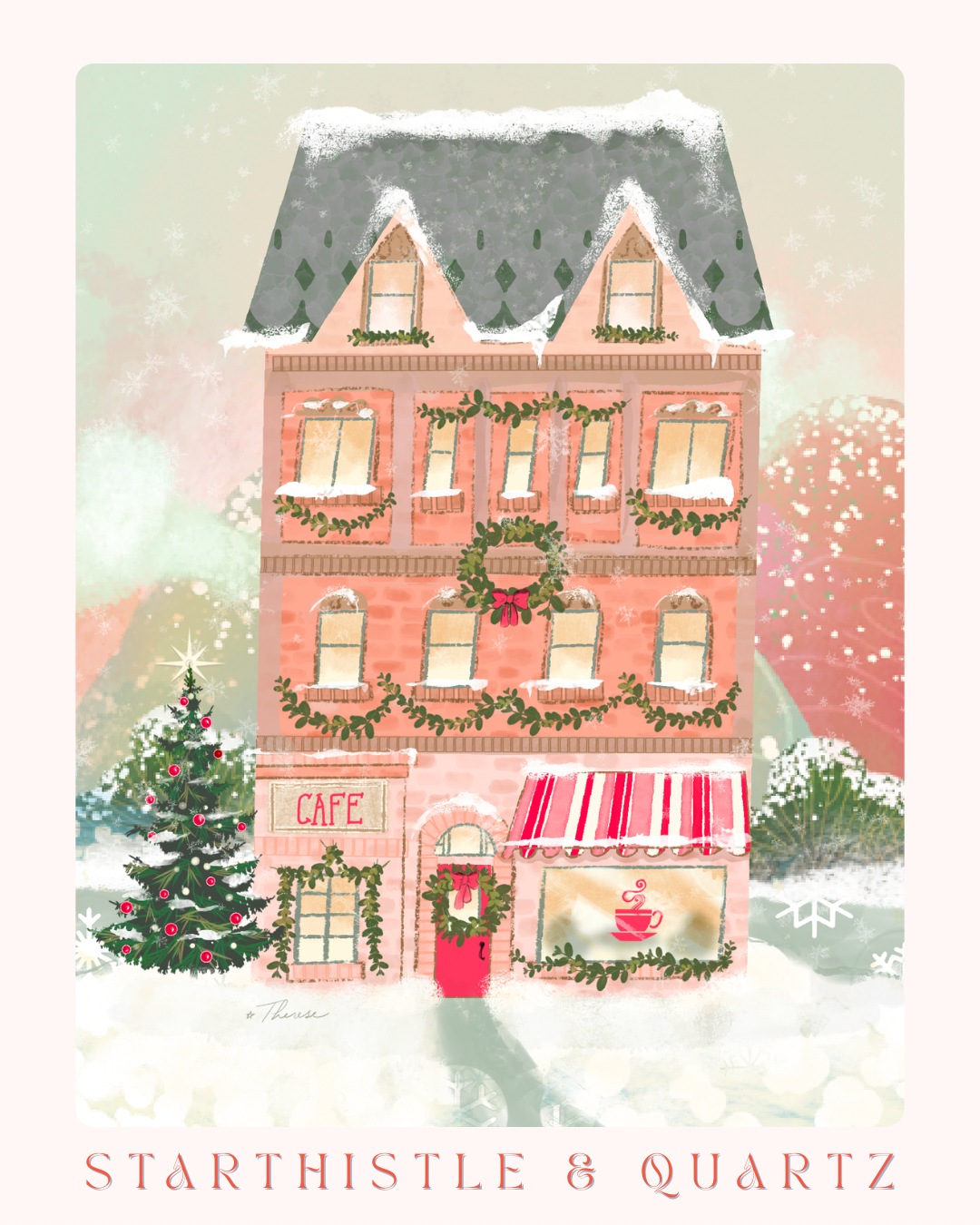
“Cocoa Cafe” by Therese Tucker for #tinseltown2025 challenge.
There’s a quiet revolution that happens when an artist shifts from asking, “Am I good enough?” to asking, “How can I grow from this?” That’s the difference a growth mindset can make. In this post, I want to share what this shift looks like in real time: the messy, hopeful, vulnerable truth about creating art when your inner critic is loud, your skills are evolving, and your dreams are huge.
Whether you're in a season of expansion or frustration, I hope these thoughts will help you reconnect to your creative path and keep walking it with love.
1. What a Growth Mindset Looks Like in Real Life
For me, a growth mindset as an artist means deeply believing that my skills, talents, and voice aren’t fixed. They’re alive and expanding with every brushstroke, sketch, or creative decision I make.
Even when a piece doesn’t turn out how I hoped, I’ve learned to trust that each session sharpens my hand and my eye, and takes me one step closer to the artist I’m becoming.
2. What It Feels Like When I’m Stuck in a Fixed Mindset
Every time my inner critic flares up, I know I’m brushing up against a fixed mindset. It’s that harsh, “reasonable-sounding” voice that tells me my work isn’t good enough, or that someone else’s style or polish means I should just quit trying.
Recently, while working on the #TinselTown2025 challenge, a cozy Christmas village illustration series, my self-doubt came in fast. I love this style of work, but I don’t feel confident in it yet, and my inner critic had a lot to say about how “wrong” it all looked.
Fixed mindset thinking makes you feel like you’re trapped in a box, with only one “right” way to make art. And that’s a lie.
3. How I Shift Back into Growth Mode
When I catch myself spiraling, I remind myself: This is just one piece. It’s not the defining moment of my career. It’s one brushstroke in a much bigger picture.
I also work with my nervous system with a few deep breaths, a body shake, a little movement to get my energy flowing again. I remind myself that moving the body helps move the mind.
Growth lives in motion, not perfection.
4. A Trick That Helps Me Regain Perspective
When things start feeling visually or emotionally “off,” I give myself permission to walk away. Distance softens the critical voice and resets your eyes.
Sometimes, I even invert my body by hanging my head over the edge of the bed upside down or do a stretch to literally shift my view. It sounds simple, but changing how you look at your work helps you feel differently about it too.
5. To the Artist Who’s Feeling Behind…
Have compassion for yourself. You feel this way because you care deeply. That’s a beautiful thing.
If your vision feels far away, know that most dreams are made up of tiny steps, not giant leaps. There are days when I can only sketch for 5 minutes. But that 5 minutes helps me feel my momentum.
If I showed up today, then I’m closer to my dream than I was yesterday. And so are you.
6. Want Support for Your Creative Growth?
If this post resonated, you might love some of the spaces I’ve created to support other sensitive creatives:
🎨 Follow my journey on Patreon — See my collections unfold, get exclusive access to stickers, postcards, behind-the-scenes process, and more.
🌠 Try the free Dream Lab — My guided tool to help you clarify your soul-aligned “North Star” so you can turn big dreams into grounded direction.
🌙 Join the Epic Year Workshop — This workshop turns your soul-aligned dream into a 12-month creative strategy rooted in nervous system alignment, numerology + your progressed moon.
Final Thoughts
You don’t need to be perfect to be powerful. You don’t need to be the most polished to be on your path. You just need to keep showing up.
If you’ve been looking for a sign to keep going — this is it.