
Why Your Inner Critic Blocks Your Creativity (And the Brain Science Behind What Happens When You Ignore It)
There is a very specific moment when my inner critic likes to show up.
Not halfway through a painting. Not when I'm deciding whether to share my work publicly. It shows up right at the beginning, in that fragile space between having an idea and actually starting it. That moment when something feels exciting and alive and full of possibility.
And then the critic clears its throat.
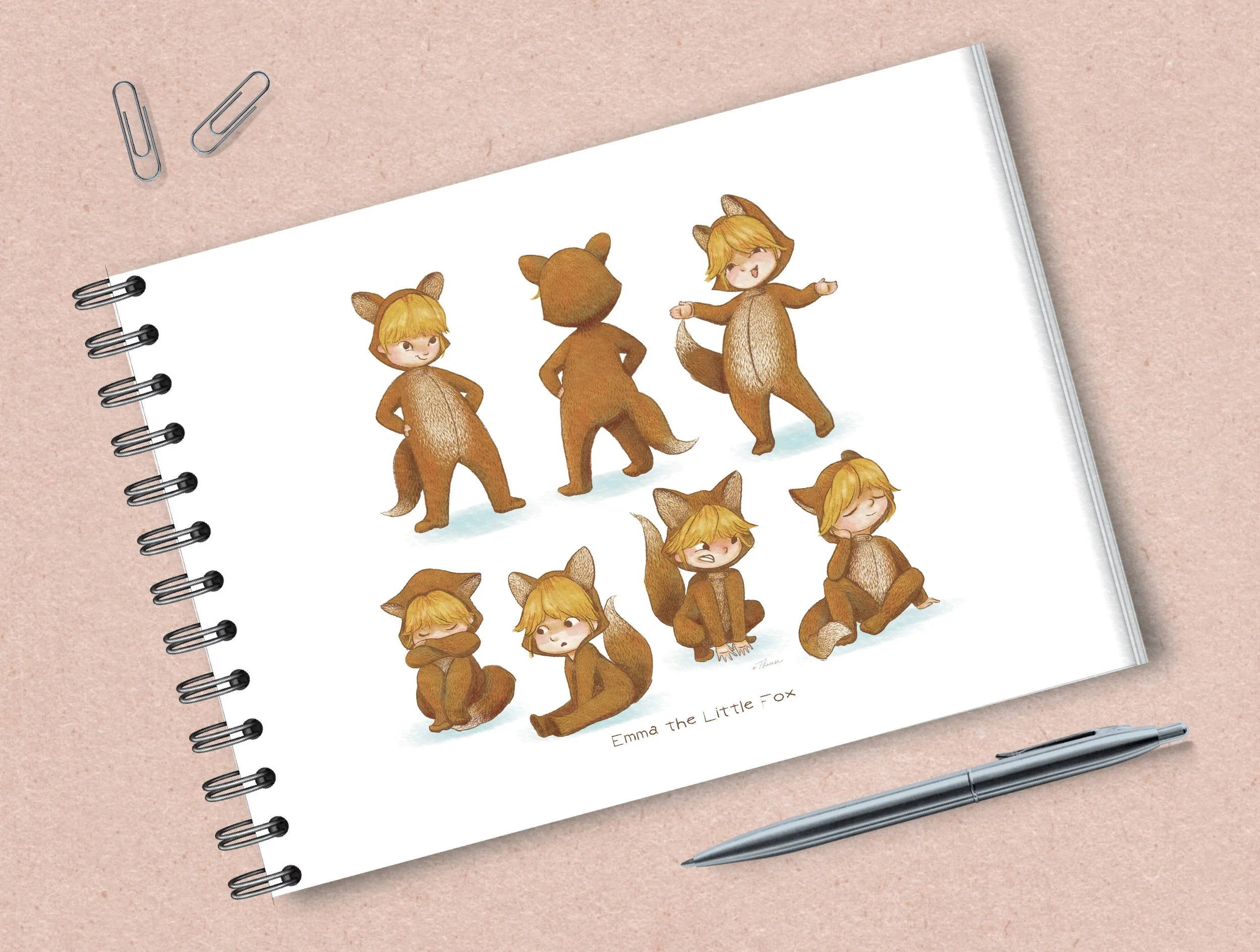
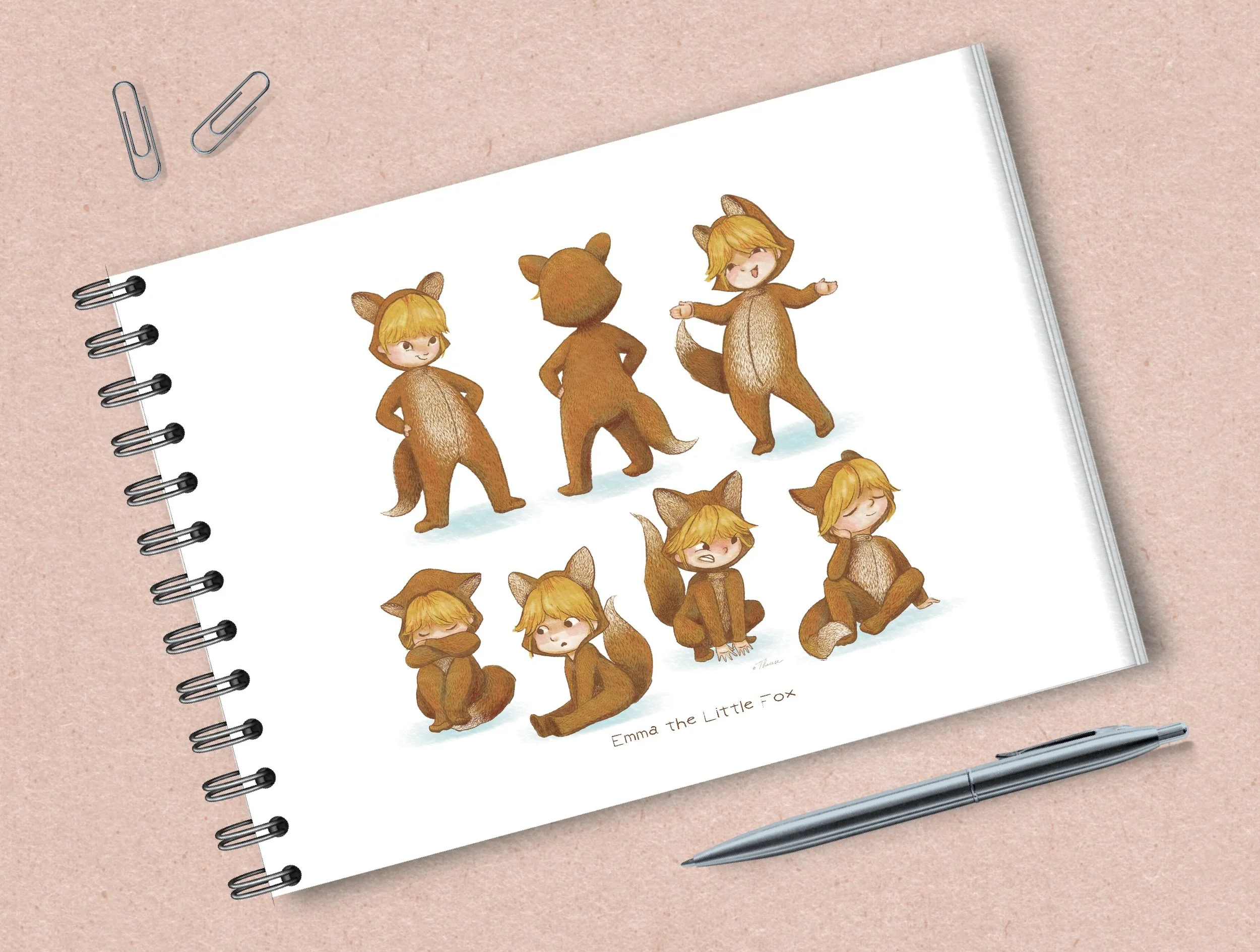
My Character Development page for my portfolio that my inner critic didn’t want me to make.
There is a very specific moment when my inner critic likes to show up.
Not halfway through a painting. Not when I'm deciding whether to share my work publicly. It shows up right at the beginning, in that fragile space between having an idea and actually starting it. That moment when something feels exciting and alive and full of possibility.
And then the critic clears its throat.
What makes mine particularly tricky is that it doesn't shout or insult me, at least not right away. It shows up sounding reasonable. Almost professional. Like an art director pulling me aside to give me some hard truths.
It says things like: you didn't go to school for illustration. You don't really know the design rules. Your composition is probably weak. You should study composition before you start this piece if you want it to be competitive.
And here's the sneaky part. That doesn't sound like an attack. It sounds like preparation. It sounds responsible. It sounds like something a serious artist would do before beginning important work.
But what I eventually realized is that this voice wasn't helping me move forward. It was quietly making sure I never began.
What the Critic Actually Does to Your Brain
When I started doing deeper work around my inner critic, I got curious about what was actually happening inside me when that voice took over. So I started researching the psychology of creativity, and what I found explained everything.
When we criticize ourselves while creating, we dysregulate our nervous system. The brain interprets harsh self-judgment as a threat. And when that happens, it shifts resources toward survival. The amygdala activates, stress hormones rise, and access to the prefrontal cortex, which is where creative thinking, imagination, flexible problem solving, and flow states actually live, decreases significantly.
In other words, the inner critic shuts down access to the exact skills it claims you don't have.
I had to sit with that for a minute when I first understood it. Because it means that every time I listened to that voice telling me I wasn't ready or skilled enough, I was actually making it harder to access the skills that were already there.
The Morning I Said "Eff It"
Here's the moment that made this real for me.
I have been building my children's book illustration portfolio, and one of the things I needed to show was that I can draw children. It's not a subject I draw very often, and the weight of how important it was to get right got my critic absolutely revved up. So I kept avoiding it. The task felt enormous and the stakes felt high and every time I sat down to try, something would pull me away.
Until one morning I did some inner work, regulated my nervous system, and decided today was the day. But I gave myself one rule: go for messy. No pressure to make anything good. Just fill one sketchbook page with a few figures, in whatever style my hand wanted to make.
Before I knew it I had filled two sketchbook pages with twelve figures, and I was actually enjoying myself. It was easy. The moment I took all the pressure off and gave myself permission to be messy, even bad, the exact opposite of what my critic predicted happened.
The skills were already there. They had been there the whole time. My critic had just been standing in the doorway blocking my access to them.
Since that day I have been developing those figures into a full character. I finished a character development page for my portfolio. And right now I am in the middle of creating a story scene with my little character interacting in her world. I have the preliminary sketches done and I keep stopping and thinking, "I can't believe I'm here. This is the place I've been trying to get to for months, and it's happening, and it's easy."
That is what becomes possible when you bypass the critic.
The Critic Isn't Gone, It's Just on a Coffee Break
I want to be honest with you about something, because I think a lot of advice around the inner critic makes it sound like you defeat it once and it disappears forever.
That hasn't been my experience.
My inner critic is still there. It's just that right now, when I acknowledge that my work is good and I feel genuinely proud and hopeful about where it's going, it knows I'm not going to listen. So it steps back. It waits. It's on a coffee break, biding its time until I feel vulnerable again.
But here's what's different now: I know what happens in my brain when I bypass its stalling techniques. I know that the voice that sounds like professional guidance is actually just fear dressed up in a blazer. And I know that the moment I ignore it and just start making something, I get access to the part of myself that can actually create.
That knowledge changes everything.
Healthy Critique Versus the Inner Critic
I don't think judgment itself is the enemy. Judgment has a place in creative work. It helps us refine, improve, and develop a stronger eye over time.
But there is a real difference between healthy critique and the inner critic.
Healthy critique sounds like: this composition could be stronger, let me look at the balance of the elements.
The inner critic sounds like: you don't know what you're doing.
One is focused on the work. The other is attacking the artist. And when our identity gets tangled up in the outcome of a piece, creativity becomes tense and defensive. But when we approach our work with curiosity and a sense of play, we relax. And when we relax, we get access to everything we've actually learned.
One Thing Worth Remembering
My thoughts are not facts. Just because a voice appears doesn't mean it's telling the truth.
If someone outside of you constantly discouraged your progress, questioned your abilities, and talked you out of starting things, you would stop listening to them pretty quickly. The inner critic deserves the same scrutiny.
You likely have more skill than you realize. But when you are stuck in perfectionism or self-criticism, you lose access to it. Your creativity lives in a part of the brain that thrives on curiosity and play, not judgment.
So the next time your inner critic tells you to wait until you're more ready, more trained, more prepared, you might try doing the opposite.
Go for messy. Fill one page. See what your hand already knows how to do.
Because the artist you've been waiting to become might already be there, just waiting for the critic to take a coffee break.
If You Want to Watch the Shaping in Real Time
I share this whole stage inside my Patreon, the works in progress, the portfolio building, the experimenting, the refining. It's not polished. It's honest. And if you're building something too, I think you'd feel right at home there.
And if you're feeling lost in the woods right now and need help reconnecting with your North Star, the Starlight Dream Lab is a beautiful place to begin. It's where we do the deeper work of remembering what you're actually building toward.
Keep going, beautiful soul.